
Your claim paperwork tells you what the insurer thinks the roof costs to replace (RCV), what it pays now after depreciation (ACV), what it may release later once work is done (recoverable depreciation), and what comes off for your deductible. Read your declarations page and the adjuster's estimate line by line, and ask your insurer about anything unclear.
After a hail or wind claim, most Oklahoma City homeowners receive an adjuster's estimate full of abbreviations and a check that looks smaller than they expected. Much of the confusion comes from three or four terms that change how much is paid and when.
This guide explains those terms in plain English. It is general information, not legal or insurance advice. You own your claim, and your policy and your insurer have the final word. We are roofers, not public adjusters, so our job is to document the roof and explain the work, not to negotiate for you.
Start with your declarations page
The declarations page, often called the dec page, is the summary at the front of your policy. It lists your dwelling coverage amount, your deductibles and any special endorsements. Look for a separate line for wind and hail, and for any wording about how roofs are paid, such as a roof payment schedule or actual cash value for roofs.
Read it before the adjuster comes out. If you know your deductible and roof settlement terms ahead of time, the numbers on the estimate will make sense instead of feeling like a surprise.
Replacement cost value (RCV)
RCV is the insurer's estimate of what it costs today to replace the damaged roof with materials of like kind and quality. It is usually built line by line in estimating software: tear-off, underlayment, shingles, drip edge, starter, ridge cap, vents, flashing, labor and so on, priced for your area.
On the estimate, RCV is usually the biggest number. It is the ceiling of what your policy may pay for that scope, but it is not always what you are paid up front.
Check the measurements first. The estimate lists roof area in squares (one square is 100 square feet), plus lengths of ridge, hips, valleys, eaves and rakes. If a slope, a detached garage or a porch roof is missing, or the pitch is listed lower than it really is, the RCV will be too low. Those are factual errors your insurer can correct when you point them out with photos or a measurement report.
Actual cash value and depreciation
Actual cash value, or ACV, is the RCV minus depreciation, which is the insurer's estimate of how much value the roof had already lost to age and wear. A 15-year-old roof will carry much more depreciation than a 3-year-old roof. Your first check is often based on ACV minus your deductible.
Whether that depreciation comes back to you depends on your policy. Some Oklahoma policies pay roofs on an ACV basis only, meaning depreciation is never paid. Others pay replacement cost, holding back depreciation until the work is finished. Depreciation may also be applied to labor on some estimates, so read the depreciation column line by line rather than only the total.
Recoverable depreciation
On a replacement cost policy, the held-back amount is called recoverable depreciation. After the roof is replaced, you or your roofer send the insurer the final invoice and proof of completion, and the insurer releases the remaining amount up to what the work actually cost. Most policies set a time limit for finishing the work and asking for it.
If the estimate lists depreciation as non-recoverable, that money is not coming back. Ask your adjuster which applies, and write down the deadline for completing the work.
Wind and hail percentage deductibles
Many Oklahoma policies have a wind and hail deductible set as a percentage of your dwelling coverage rather than a flat dollar amount. A 1 or 2 percent deductible on a home with a large dwelling coverage amount adds up quickly, and it is subtracted from the claim payment before anything else.
Because that deductible can be large, small claims sometimes pay nothing. It is worth knowing your exact deductible before you decide whether to file, since even a claim that pays nothing may appear in claim history databases.
- Find the deductible on your declarations page, labeled wind/hail or named storm
- Multiply the percentage by your dwelling coverage to get the dollar amount
- Compare that to the likely repair scope before filing
- Remember the deductible is yours to pay, and a roofer offering to cover or absorb it is a red flag
Supplements: when the scope changes
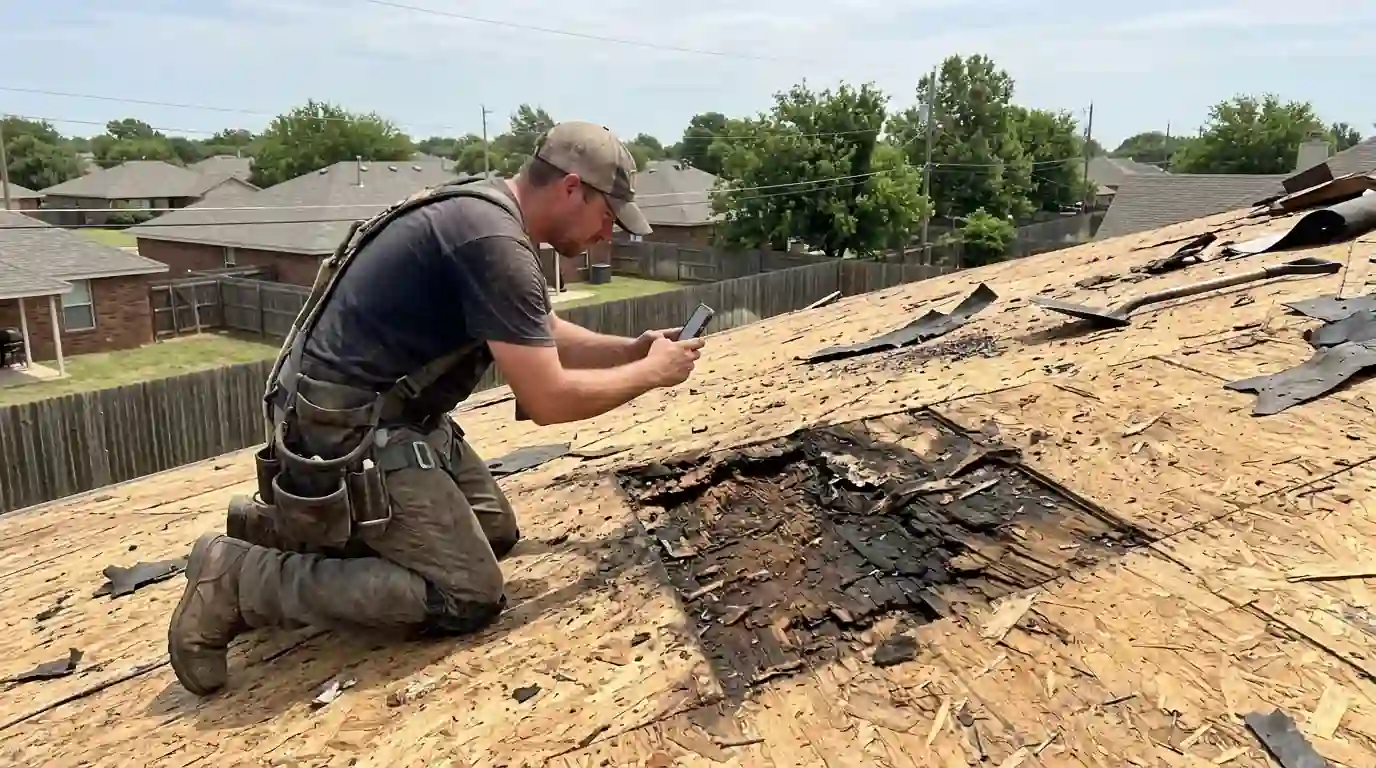
An adjuster's first estimate is made from the roof surface. Some items only show up during the job: rotted decking under the shingles, a second layer nobody saw, or flashing that has to be rebuilt. A supplement is a request to the insurer to review those added items with photos and measurements.
Supplements are normal, but they should be backed by evidence, not padding. A good roofer photographs the deck, the hidden layer or the failed flashing before covering it, so the insurer can see why the work was needed. The insurer decides whether to add it.
Code items and ordinance coverage
Building codes change. Replacing a roof today may require items your old roof never had, such as drip edge, ice and water shield in valleys, or specific ventilation. These are often called code items. Whether they are paid depends on your policy's ordinance or law coverage, which is sometimes a separate limit on the dec page.
If code items are missing from the estimate, ask your adjuster whether your policy includes ordinance or law coverage and what documentation they need, such as a reference to the local code requirement.
Keep a simple claim file while all this happens: the claim number, the adjuster's name and contact details, every estimate version, photos, letters and notes from each phone call with the date. When questions come up months later about recoverable depreciation or a supplement, that file saves a lot of time.
Where Sapphire fits in your claim
We inspect the roof, photograph damage slope by slope, and explain what we see. If you open a claim, we can meet your adjuster on the roof so both of us look at the same evidence. When we find hidden damage during the job, we document it and give you the photos for your insurer.
We do not negotiate your claim, act as your adjuster, or tell you what your insurer owes. Your policy is a contract between you and your insurer. Call Sapphire any time with questions about the roof itself; we answer 24/7.