Seamless Gutters
Seamless gutters rolled on site, sized for Oklahoma downpours, with downspouts placed to keep water off your foundation.
Learn moreNo gutter guard makes a gutter maintenance-free. What a good guard does is turn twice-a-year ladder work into a quick brush-off, keep downspouts from packing solid, and stop gutters from overflowing in the middle of a spring downpour because a mat of leaves sealed the outlet.
Answered 24/7Call (405) 864-0080 and talk to Sapphire.
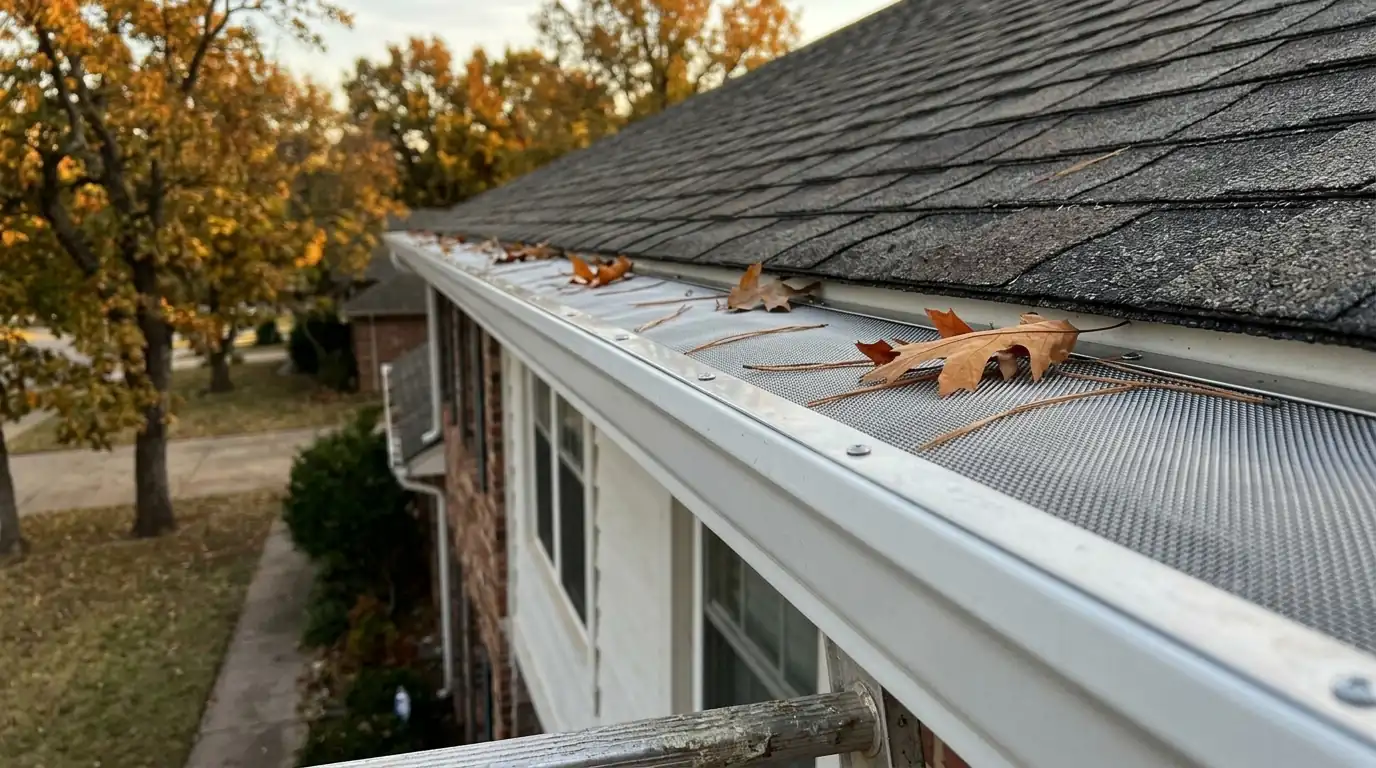
Gutter guards cover the top of your gutters so leaves, needles and seeds stay out while water still drains in. In Oklahoma City, micro-mesh guards handle the widest mix of debris, including pine needles and elm seeds, while simple screens suit homes with mostly large oak leaves. The right guard depends on your trees, roof pitch and gutter size.
Sapphire installs gutter guards across the metro, from the big post oaks in Nichols Hills and Edmond to the pines and red cedars planted along newer subdivisions in Yukon and Mustang. We look at what's actually falling on your roof before we recommend a type, because the guard that works under an elm can fail under a pine.
Perforated and expanded-metal screens are the simplest guards. They sit over the gutter with holes roughly a quarter inch or larger, which stops whole leaves but lets smaller debris through. They're a decent fit for homes under large oaks and sycamores where most of the fall is broad leaves.
Micro-mesh guards use a fine stainless mesh stretched over a rigid frame. They block almost everything, including pine needles, shingle granules and the papery elm seeds that pile up every spring. Reverse-curve or surface-tension guards wrap a solid hood over the gutter so water follows the curve in while leaves slide off the edge.
Oklahoma City's older neighborhoods are full of oaks, elms, maples, pecans and sweetgums, and each sheds something different. Pecans drop leaflets, husks and catkins. Sweetgums drop spiky seed balls that wedge in downspouts. Siberian and American elms let go of thousands of flat seeds in early spring that pack into wet mats.
Newer subdivisions often have pines, Eastern red cedars and Bradford pear trees close to the house. Pine needles are the hardest test for any guard because they slip through screens point-first and lodge upright. Cottonwoods along creeks and the Oklahoma River add a cottony fluff in late spring that clings to coarse mesh.
A guard has to accept the water a roof sends it. On steep roofs, water moves fast enough that a reverse-curve hood can let it shoot past the gutter during a heavy storm. Micro-mesh guards angled to follow the roof pitch handle steep slopes better, and we add splash diverters below valleys where water hits hardest.
Guards also need a gutter worth protecting. If the runs are undersized, sagging or hail-dented, the guard will only hide those problems. We check pitch and hangers first and recommend gutter repair or replacement when the gutter itself is the real issue.
Central Oklahoma gets a handful of ice events most winters, and the October 2020 ice storm showed how much damage ice can do in a few hours. A guard can hold a thin layer of ice on its surface, and on a north-facing eave that stays shaded, meltwater may refreeze along the front edge.
That's not a reason to skip guards, but it does shape how we install them. Fastening the guard into the gutter lip rather than lifting shingles, keeping the guard pitched so water drains off rather than sitting, and making sure the attic is ventilated so the roof isn't warming snow from underneath all help ice clear faster.
Some guard systems slide under the first course of shingles. That can break the shingle seal strip and leave nails exposed, and some shingle makers frown on it. We favor guards that fasten to the front lip of the gutter and rest against the drip edge, so the roof stays undisturbed.
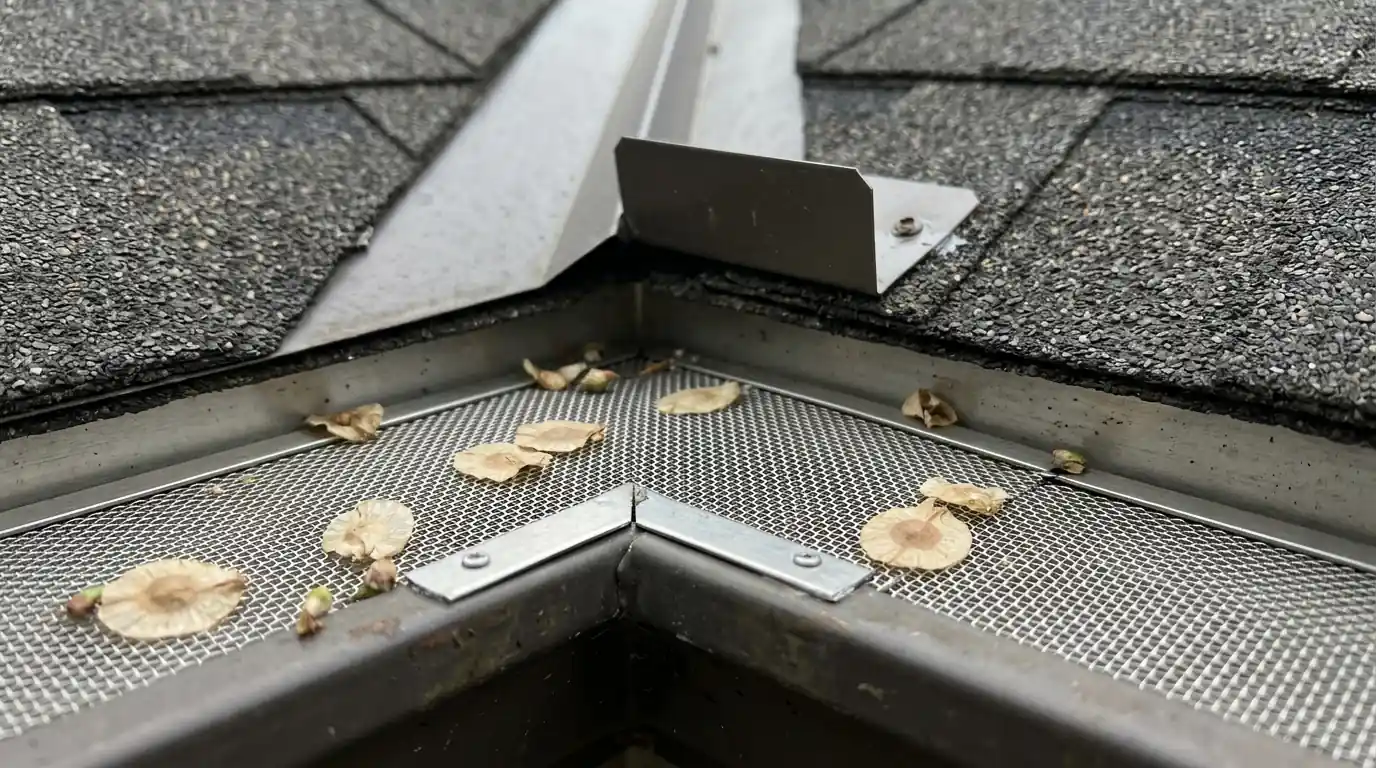
Before any guard goes on, we clean and flush the gutters, clear the downspouts, check the outlets, and tighten loose hangers. Then we fit the guards around corners and valleys with trimmed pieces, not gaps, since an open corner is where needles and seeds pile in first.
With micro-mesh, most homeowners only need to brush the surface off once or twice a year, often after the spring elm seed drop and again after the fall leaf drop. A soft brush on a pole or a leaf blower from the ground clears most of it.
Every few years, a quick check of the downspouts and the gutter interior is still smart, because fine silt and shingle granules can settle in even well-guarded gutters. We can look at that during a roof inspection so you aren't climbing ladders for it.
If you're up a ladder every spring and fall and gutters still overflow, guards will cut that work down sharply.
Needles stacked inside downspouts are the classic clog that only a fine mesh guard really stops.
Small trees sprouting in the gutter mean debris has been composting there for months.
Water spilling only below a valley in hard rain often means debris is packing at that corner.
Birds and squirrels build in gutters full of leaves, and a guard takes away that easy nesting spot.
Bent, rusting or crushed screens let debris in and can collect more than they keep out.
The same people who look at your roof are the ones who do the work, and they explain each step before it happens.
Call (405) 864-0080We note which trees overhang the house, how steep the roof is and how your gutters are sized before suggesting a guard.
We explain the trade-offs between screen, micro-mesh and reverse-curve for your debris and pitch.
We flush gutters and downspouts, reset loose hangers and fix pitch so the guard sits on a working gutter.
Guards are fastened to the gutter lip, trimmed around corners and valleys, and checked for gaps.
We run a hose along the roof edge to confirm water drops through the guard and drains out every downspout.
Every roof is priced after we have seen it. These are the things that move the number up or down.
Call any hour. Our own crew inspects, photographs and explains the fix before any work starts.
Stainless micro-mesh guards handle pine needles far better than screens, because the openings are too fine for a needle to slip through point-first. Needles may still rest on top, but they dry and blow off or brush away easily.
A guard can hold a skim of ice, especially on shaded eaves, but properly pitched guards and a well-ventilated attic help it clear quickly. Gutters packed with wet leaves cause worse ice problems because the whole gutter freezes solid and adds weight.
A fine mesh guard keeps the flat elm seeds that fall in early spring on top of the gutter instead of inside it. The seeds dry out and can be brushed off, rather than forming a wet mat that blocks the outlet.
They can, but dented gutters often have kinked faces or bent lips that keep a guard from sitting flat. If the gutters were damaged by hail, it's usually better to replace them first and add guards to the new runs.
Less often, but yes. Expect to brush off the guard surface once or twice a year and have the inside of the gutters and downspouts checked every few years for fine silt and shingle granules.
Seamless gutters rolled on site, sized for Oklahoma downpours, with downspouts placed to keep water off your foundation.
Learn moreGutter repair for sagging runs, leaking seams and end caps, bad pitch and the rotted fascia hiding behind them.
Learn moreYearly and after-storm roof tune-ups in the OKC metro: sealant at penetrations, clear valleys and gutters, fix small issues early.
Learn moreStructural roof repair after a limb or trunk lands on your house, from punctured decking to cracked rafters and crushed ridges.
Learn moreOklahoma City and the surrounding metro, including:
YukonChoctawThe VillageCanadian CountyLansbrook, Oklahoma CityCrown Heights, Oklahoma CityGatewood, Oklahoma CityWestmoore, Oklahoma CityAll service areas