Chimney Repair
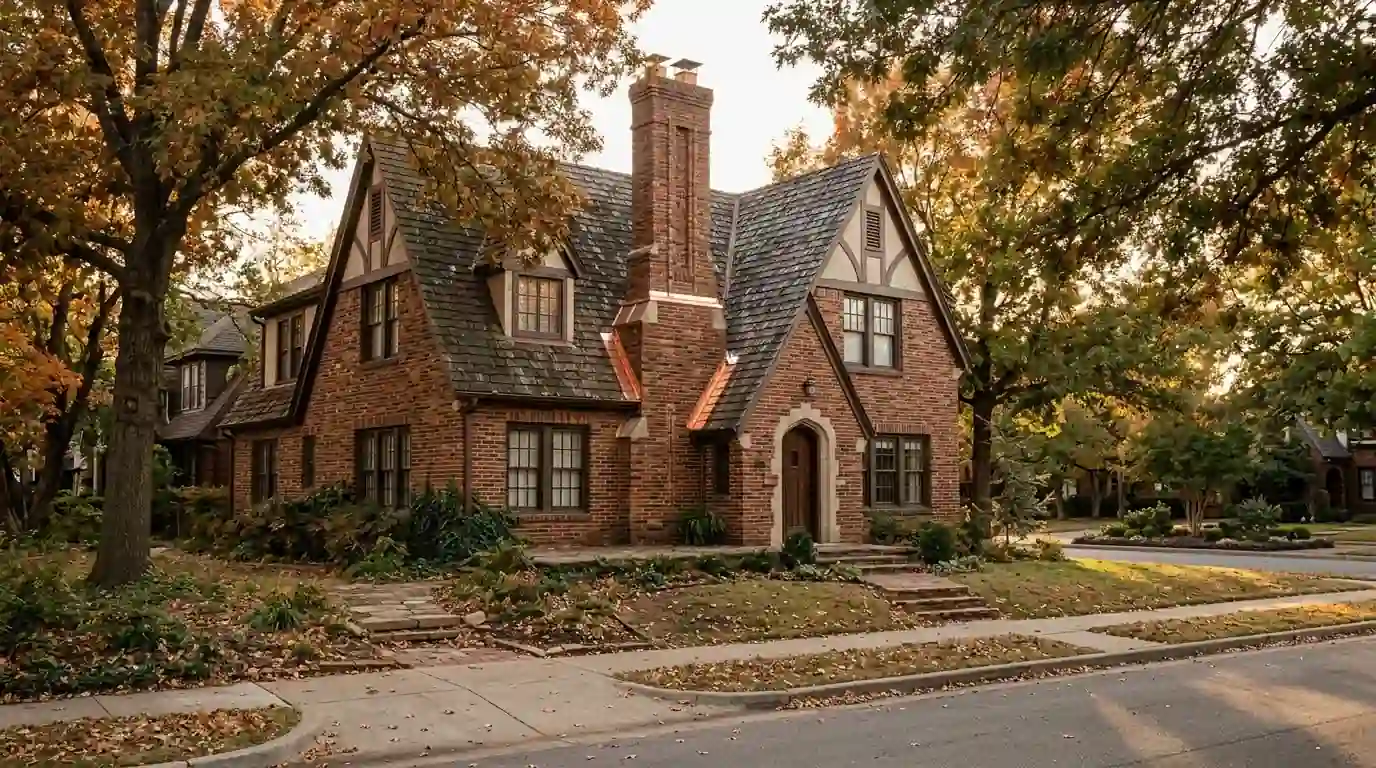
Large brick and stone chimneys on Tudor Revival homes are the most common leak source in Crown Heights, usually at failed flashing.
Learn moreSapphire Roofing repairs and replaces roofs on the 1930s Tudor and Colonial Revival homes of Crown Heights. Because the neighborhood is an Oklahoma City historic preservation district, we plan material choices around the city's design standards and the approval process. We inspect, photograph and explain, our own crews do the work, and we answer calls 24/7.
Answered 24/7Our own crews work in Crown Heights.
Crown Heights sits between NW 36th and NW 42nd streets, from Walker Avenue west to Western Avenue. Developer G. A. Nichols began building it in 1930 on land that had been the Oklahoma City Golf and Country Club, whose clubhouse stood near NW 40th and Western. Lots went on sale in October 1930, and the neighborhood was about 95 percent built out by 1941.
Part of the old golf course became Crown Heights Park, which straddles Shartel Avenue along a natural ravine. Landscaped Shartel medians, mature trees and historic street lighting give the neighborhood its look, and the roofs are a big part of that character.
Roughly 40 percent of Crown Heights homes are Tudor Revival and about 35 percent are Colonial Revival, with Minimal Traditional, Spanish, Monterey, French Eclectic and a few International Style and Art Deco houses mixed in. Tudor homes have steep front-facing gables, tall chimneys, and roof planes that sweep low over entries.
Those steep cross-gables create valleys and wall joints on almost every elevation. Chimneys on Tudor houses are often massive brick or stone stacks set right where two roof planes meet, and the flashing around them is the most frequent leak point we find in this neighborhood.
Crown Heights is an Oklahoma City Historic Preservation district. Under the city's rules, changes to buildings in HP zoning need a Certificate of Approval, issued either by Planning Department staff or by the Historic Preservation Commission. Work is judged against the city's Design and Sustainability Standards and Guidelines for historic districts.
The standards treat repair of less than half of a feature on one side of a building as maintenance, while larger replacements are subject to review. A full re-roof or a change of material usually falls in that second group. We give you product details, colors and photos for the application, and we do not start work that needs approval until you have it.
The city's guidelines ask owners to repair original features where they can, and when that is not possible, to replace them in kind with the same or similar material. On a Crown Heights house, that might mean matching a shingle profile and color closely, or salvaging original slate or clay tile to patch a damaged area.
We look first at whether a leak can be fixed with flashing, a section of new underlayment and matched material. When the roof truly is worn out, we discuss materials that meet the standards and still hold up to Oklahoma City hail.
The neighborhood association has supported tree planting and replacement for decades, and the canopy over Crown Heights streets is thick. Limbs that hang over steep roofs scrape shingles, drop debris into valleys and keep north slopes damp, which leads to moss and early wear.
The October 2020 ice storm brought down limbs across Oklahoma City, and the large, old trees in central neighborhoods like this one carry heavy limbs over the roofs below. When a limb comes through a roof, we tarp it right away and then plan the permanent repair to match the existing roof.
Homes from the 1930s were usually built with board sheathing rather than plywood. Many have been re-roofed several times, and some still carry two layers of shingles. During a tear-off, we check every board for rot, cracks and wide gaps and replace sections as needed.
Original attics in these homes often have little ventilation, and later insulation sometimes blocks what venting there was. We look for ways to add intake and exhaust that are hidden from the street, since visible changes to a historic roof can affect the review.
Large brick and stone chimneys on Tudor Revival homes are the most common leak source in Crown Heights, usually at failed flashing.
Learn moreSteep cross-gables create many valleys and wall joints where old flashing gives out after decades of heat and freeze cycles.
Learn moreHistoric district guidelines favor repairing original roofs where possible, so targeted repairs are often the first step here.
Learn moreBoard sheathing on 1930s homes often has cracked or rotted sections that need replacing during a tear-off.
Learn moreThe mature tree canopy over Crown Heights drops limbs on roofs during wind and ice storms.
Learn moreCall Sapphire. Our own roofers inspect, photograph and fix the problem, and we explain it first.
Crown Heights is an Oklahoma City historic preservation district, so work that replaces more than half of a feature on one side, such as a full re-roof or a change in material, is generally subject to review for a Certificate of Approval. We provide product details and photos for your application.
Often, yes. Most chimney leaks come from worn step and counterflashing or a cracked crown, and those can be rebuilt without replacing the whole roof. We photograph the problem and show you the fix.
We look for shingles, slate or tile that match the existing profile and color as closely as possible, and we can reuse salvaged original material on repairs. We explain where an exact match is not available.
We tarp any openings first to protect the interior, then document the damage with photos. Repairs that only restore what was there are usually treated as maintenance, while larger changes go through the city's review.