Class 4 Impact-Resistant Shingles
UL 2218 Class 4 impact-resistant shingles for Oklahoma City hail country, explained honestly and installed by our own crew.
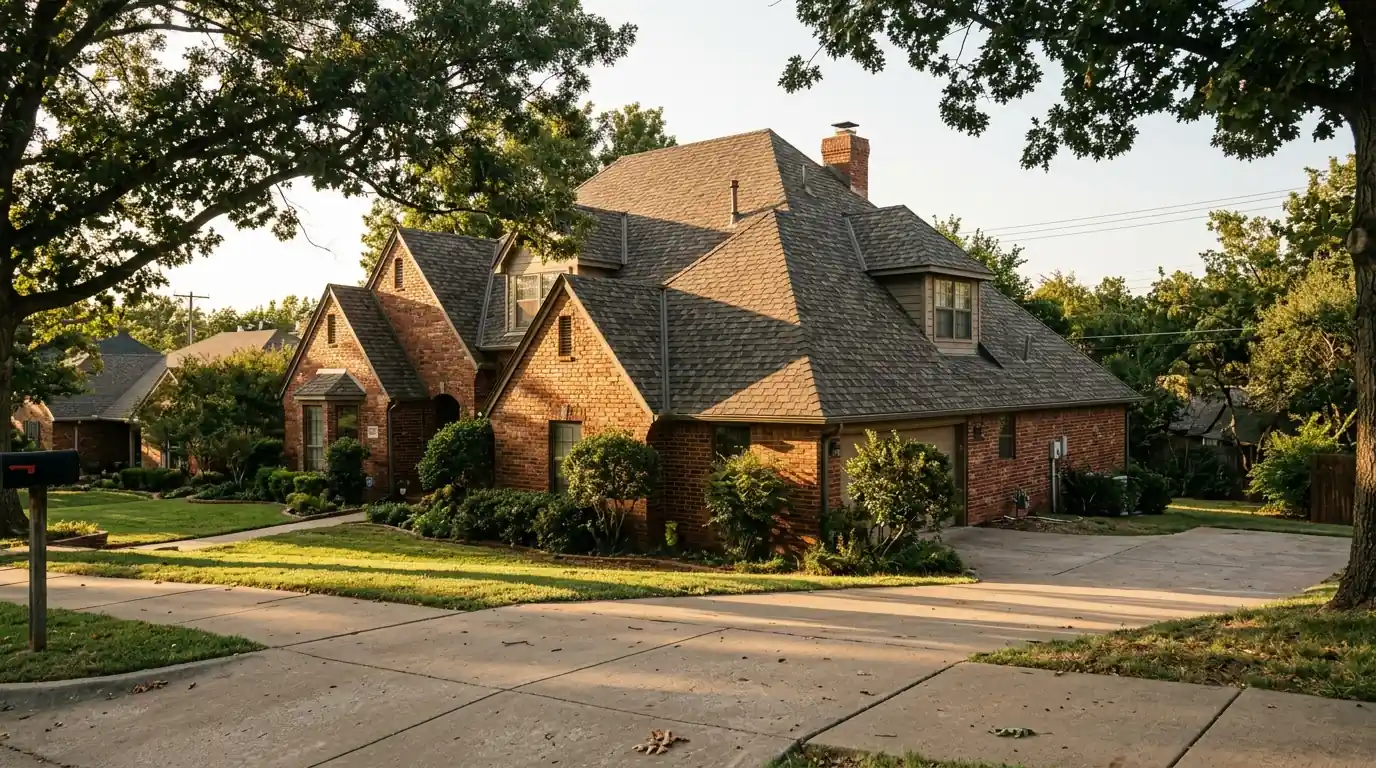
Learn moreDrive any street in the metro and most roofs you see are asphalt shingles. They suit the wide range of homes here, from postwar bungalows to new two-story builds, and they are straightforward to repair after the hail and wind that come through every spring.
Answered 24/7Call (405) 864-0080 and talk to Sapphire.
Asphalt shingles are the most common roof in Oklahoma City because they are affordable, easy to repair, and come in many colors and styles. Most homes now get architectural (laminated) shingles, which are thicker and more wind resistant than old three-tab. How the shingles are nailed and sealed matters as much as which product you pick.
Not all shingles are equal, though. Sapphire installs asphalt shingle roofs with our own crews, and this page explains the differences between shingle types, how color affects attic heat, what wind ratings really mean, and why nailing is where good and bad shingle jobs part ways.
Three-tab shingles are a single flat layer cut into three tabs, which gives the roof a uniform, brick-like pattern. They are lighter and thinner, and many manufacturers have reduced or dropped their three-tab lines. Today they are mostly used for sheds, rentals or as starter strips.
Architectural shingles, also called laminated or dimensional, bond two layers together to create shadow lines and a varied look. The extra mass makes them stiffer against wind and gives them a longer expected life than three-tab. This is what most Oklahoma City homeowners choose now.
Designer or luxury shingles are thicker still and are cut to imitate slate or wood shake. They cost more and weigh more, but they can suit older homes in neighborhoods like Crown Heights or Nichols Hills where the look of the roof matters to the architecture.
Dark shingles absorb more sunlight than light ones, and in an Oklahoma City July that difference shows up as a hotter roof deck. A hotter deck pushes more heat into the attic, which can make upstairs rooms harder to cool.
Several manufacturers now offer reflective shingle colors with special granules that bounce back more sunlight while still looking like a normal gray or brown. Color is only one part of attic heat, though. Good intake and exhaust ventilation usually does more than switching from charcoal to a lighter shade.
Shingle packaging lists wind ratings in miles per hour, often tied to standard lab tests such as ASTM D7158. Those ratings assume the shingles are installed exactly to the manufacturer's instructions, including the right starter strip, nail count and sealing.
Many architectural lines reach their highest wind rating only when you use the manufacturer's matching starter strip and hip and ridge caps, plus a six-nail pattern. Straight-line winds and storm gusts in central Oklahoma can easily test a roof, so we install to the higher-wind specification instead of the minimum.
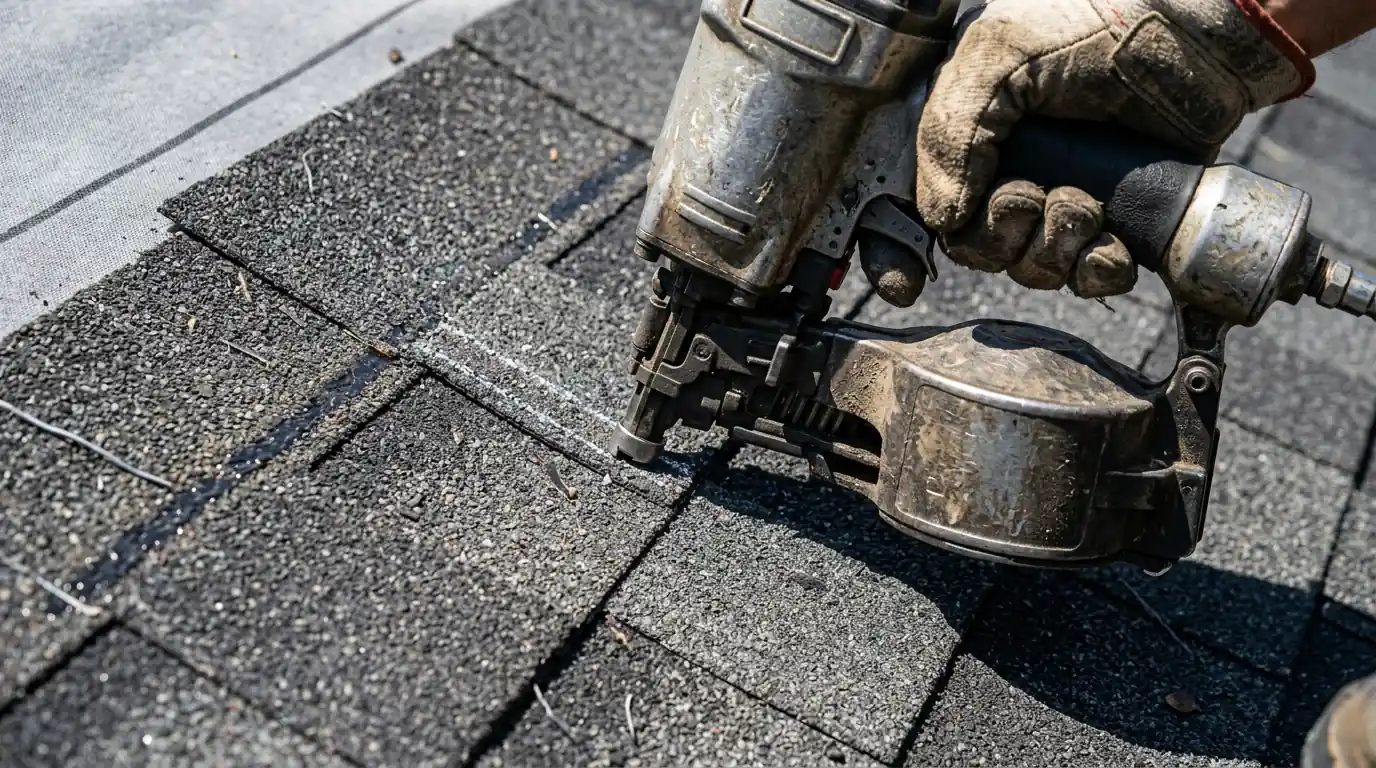
Every shingle has a nailing zone, a narrow strip where the nail passes through both laminated layers and the shingle below. Nails driven too high miss the layer underneath, and shingles can slide or blow off in the first strong wind.
Nail depth matters too. An overdriven nail cuts through the mat and loses holding power; an underdriven nail sits proud and can punch up through the shingle above. We set compressor pressure for the deck and check nailing on each slope as the crew works, especially on cold mornings when shingles are stiffer.
Each shingle has a strip of thermal sealant that bonds to the course below once the sun warms it. In summer this happens within days. Shingles installed in late fall or winter may not seal until warmer weather arrives, which leaves them more vulnerable to wind for a while.
On cold-weather installs we may hand-seal exposed edges like rakes with roofing cement, following the manufacturer's guidance. It is a small step that keeps edges from lifting before the factory strip has a chance to activate.
One reason asphalt shingles are so common here is that small damage can be fixed. A few creased tabs from a wind gust or a vent boot torn by a falling limb can often be repaired without replacing the roof.
The catch is matching. Shingles fade in the Oklahoma sun, and a repair patch on a ten-year-old roof may look darker at first. We keep repairs to the smallest area that is truly damaged and match the shingle line and color as closely as current products allow.
Heavy granule loss leaves the asphalt exposed to UV, and the shingles age quickly after that.
Shingles that curl up or down at the edges have lost flexibility and seal strength.
If your roof is thin three-tab from decades ago, an architectural upgrade adds wind resistance.
Shingles that flap during storms have lost their seal and can tear off in the next gust.
Thermal cracking from heat and cold swings lets water reach the underlayment.
A roof full of mismatched patches may be telling you it is time to reroof.
The same people who look at your roof are the ones who do the work, and they explain each step before it happens.
Call (405) 864-0080We check the shingles, the decking from the attic side, and ventilation before recommending a product.
We show samples of three-tab, architectural and designer options and talk through color, heat and HOA rules.
Old roofing comes off, decking is repaired, and underlayment, drip edge and starter strips go down.
Our crew nails each course in the marked zone with the full nail pattern and the matching ridge caps.
We check edges, hand-seal where needed in cold weather, and sweep the property for nails.
Every roof is priced after we have seen it. These are the things that move the number up or down.
Call any hour. Our own crew inspects, photographs and explains the fix before any work starts.
For most homes, yes. Architectural shingles are heavier, carry higher wind ratings, and last longer than three-tab, which matters with the strong winds and storms common here. Many manufacturers have scaled back three-tab production anyway.
Lighter and reflective-granule shingles absorb less sun, so the deck runs somewhat cooler. Ventilation and insulation usually have a larger effect on attic temperature, so we look at all three together.
The most common causes are nails placed above the nailing zone, too few nails, or shingles that had not yet sealed down when a storm hit. Proper nailing and the right starter strip prevent most of these failures.
Most manufacturers allow shingles down to a minimum slope only with extra underlayment, and below that they are not suitable. Very low porch roofs usually do better with a membrane system or standing seam metal.
Look at the brick or siding color, the trim, and what your HOA allows. We bring full-size samples so you can see them against your house in daylight, which looks very different from a small chip.
UL 2218 Class 4 impact-resistant shingles for Oklahoma City hail country, explained honestly and installed by our own crew.
Learn moreFull tear-off roof replacement in Oklahoma City, from decking checks and underlayment to a magnet sweep of your yard.
Learn moreReplacing cracked, curled or missing shingles with the closest match available, worked into the old roof without breaking it.
Learn moreBalanced intake and exhaust for OKC attics: ridge vents, soffit vents and fans set up to cut summer heat and winter moisture.
Learn moreOklahoma City and the surrounding metro, including:
McClain CountyLake Hefner, Oklahoma CityHeritage Hills, Oklahoma CitySouthern Hills, Oklahoma CityNormanDel CityPiedmontShawneeAll service areas