Roof Repair
Targeted fixes for missing shingles, worn flashing, cracked pipe boots and small leaks, done by Sapphire's own crews across OKC.
Learn moreThe most frustrating leak is the one that keeps coming back after it was fixed. Usually that's because the first repair went where the stain was, not where the water actually got in. Water is patient: it lands on the decking, rides along the underside of a board or down a rafter, and drips wherever gravity finally wins.
Answered 24/7Call (405) 864-0080 and talk to Sapphire.
A roof leak is fixed only when the real entry point is sealed, and that point is often several feet uphill from the stain on your ceiling. Sapphire traces the water path from the attic, follows it along the decking and rafters, confirms the opening on the roof, then repairs the failed shingle, flashing, boot or vent at its source.
Leak repair at Sapphire is detective work first and roofing second. Our own crews trace the path, prove the source, and fix that, so the next heavy Oklahoma rain doesn't bring the same brown ring back to your ceiling.
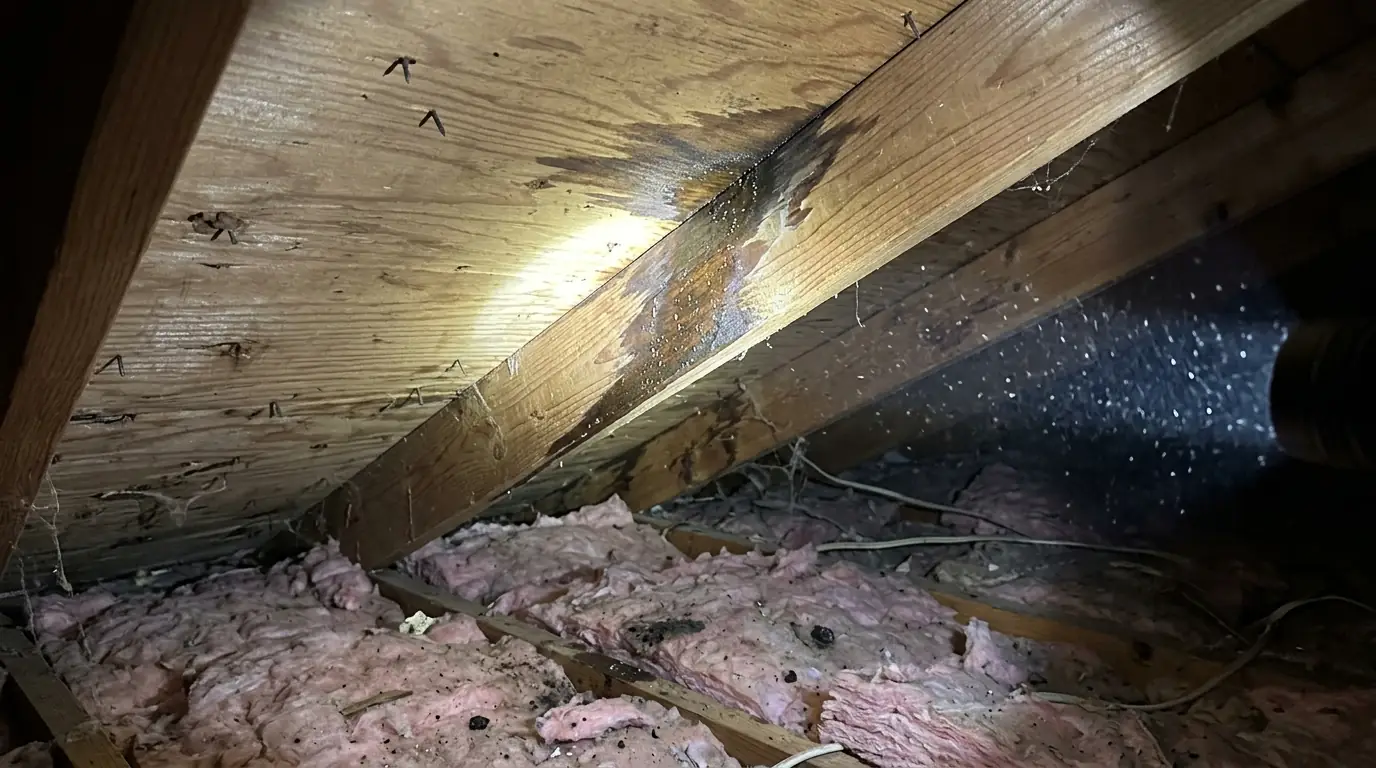
Once water gets past the shingles and underlayment, it sits on top of the decking and flows downhill toward the eave. If it finds a nail, it may run down the shank and drip there. If it reaches a rafter, it can cling to the wood and travel several feet before dropping onto the ceiling drywall.
That's why a stain near an interior wall might come from a pipe boot halfway up the slope, and a stain in the middle of a room might come from a chimney on the other side of the ridge line. Insulation adds another layer of confusion by soaking up water and spreading it sideways.
We start in the attic with a bright light, looking above the stain and then uphill from it. Dark streaks on rafters, water lines on the decking, rusty nail tips, and compressed or stained insulation all point the way. Daylight through the boards is the clearest clue of all.
Next we go on the roof directly above the trail we found and inspect everything uphill of it: shingles, nails, vents, boots, flashing and valleys. When the source still isn't obvious, we run a controlled water test, wetting one small section at a time from the bottom up while someone watches in the attic.
Across the metro, a short list causes most leaks. Cracked rubber pipe boots top it, followed by flashing that's pulled away from a brick chimney or a second-story wall, and valleys where debris built up and pushed water under the shingle edges.
Exposed nail heads that were never sealed, failed vent caps and box vents with brittle seals round out the list. On low-slope sections over porches and additions, ponding water and open seams are frequent sources, especially where the low-slope area meets a steeper shingle slope.

Some leaks only appear when rain comes from one direction. A west-wind storm can drive water sideways under a step flashing or up under a ridge vent that stays dry in a straight-down shower. Those are the leaks homeowners tell us they can't predict.
We ask a lot of questions about timing. Did it leak in the last storm or only the big one? Was the wind out of the south or the northwest? Does it show up during rain or a day later? Those answers narrow down where to look and save a lot of guessing.
Not every wet spot is rain. Condensation from an attic that doesn't vent well can drip off nail tips in winter and look exactly like a leak. Bathroom fans that dump humid air into the attic instead of outside can do the same.
HVAC equipment in the attic is another frequent source in Oklahoma homes. A clogged condensate line or a cracked drain pan can soak a ceiling in summer while the roof is perfectly dry. We check for these before recommending any roof work, because fixing the roof won't fix a sweating duct.
Once the source is confirmed, we repair it with the correct material: a new pipe boot, new step or counter flashing, replacement shingles interlaced into the existing courses, or a rebuilt valley. Roof cement alone isn't a repair, and we don't use it as one.
If the decking around the entry point is soft from repeated wetting, we cut out and replace that section before closing it up. We also show you the wet insulation or stained wood in the attic so you know what to dry out or have replaced inside.
A ceiling ring that gets a new outer line after each storm means water is still getting in.
A damp, earthy odor in the attic often means slow, hidden wetting of wood and insulation.
Bubbling paint high on an exterior wall can point to water running down from a flashing failure above.
A leak that shows up only with storms from one direction usually means a flashing or vent problem.
Orange stains around nails poking through the decking mean moisture is reaching them regularly.
If a past repair didn't hold, the real entry point was probably missed the first time.
The same people who look at your roof are the ones who do the work, and they explain each step before it happens.
Call (405) 864-0080We ask when it leaks, in which storms, and where it shows up to narrow the search before we arrive.
We follow water trails on decking and rafters uphill from the stain toward the opening.
We inspect the area above the trail and water-test when needed to prove the source.
Our crew replaces the failed boot, flashing, shingles or decking with proper materials.
You get photos of the trail, the source and the repair so you know exactly what was fixed.
Every roof is priced after we have seen it. These are the things that move the number up or down.
Call any hour. Our own crew inspects, photographs and explains the fix before any work starts.
Usually the first repair was made where the stain appeared, not where the water entered. Water can travel along decking and rafters for several feet before it drips. Tracing from the attic uphill finds the actual opening.
Yes. Attic clues like water trails, rusty nails and stained decking often lead straight to the source. When they don't, a controlled water test on the roof reproduces the leak while someone watches inside.
It could. Poor attic ventilation, bath fans venting into the attic and clogged AC condensate lines all drip onto ceilings. We check for those before recommending roof work so you don't pay to fix the wrong thing.
As soon as you can. Even a small, slow leak wets the decking and insulation over and over, which leads to rot, mold and ceiling damage that costs far more than the original fix.
We point out wet insulation and pull back what's needed to dry the area and see the decking. Larger insulation replacement can be handled as part of our attic insulation service.
Targeted fixes for missing shingles, worn flashing, cracked pipe boots and small leaks, done by Sapphire's own crews across OKC.
Learn moreRepair and replacement of step, counter, chimney, wall, valley and pipe boot flashing, the joints where most roof leaks begin.
Learn moreBalanced intake and exhaust for OKC attics: ridge vents, soffit vents and fans set up to cut summer heat and winter moisture.
Learn moreReplacing soft, rotted or delaminated OSB and plank decking so new shingles have a solid, properly nailed base to hold onto.
Learn moreOklahoma City and the surrounding metro, including:
Belle Isle, Oklahoma CityPutnam Heights, Oklahoma CityEarlywine, Oklahoma CityMidwest CityGuthrieNichols HillsCleveland CountyGaillardia, Oklahoma CityAll service areas