Modified Bitumen Roofing
Torch-down, cold-applied and self-adhered modified bitumen for OKC porches, mid-century homes and small commercial roofs.
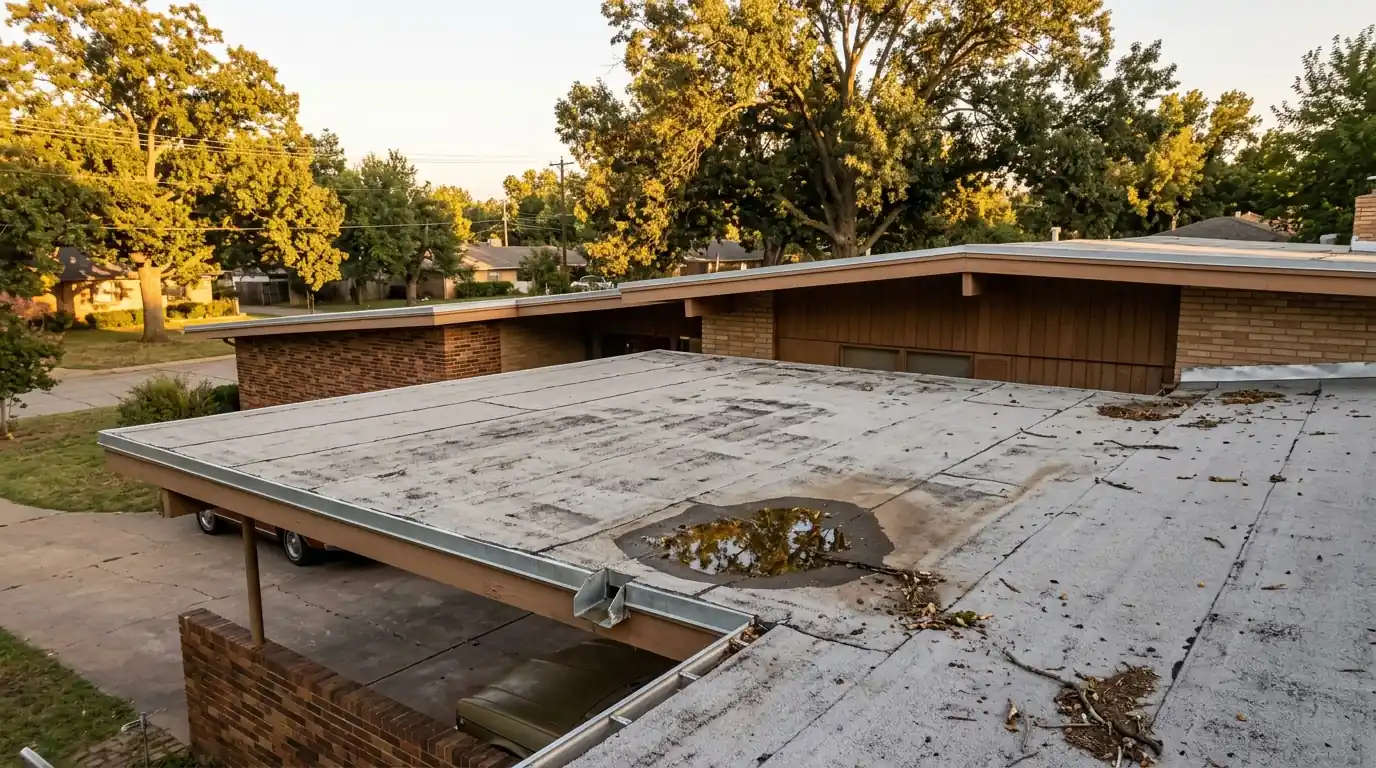
Learn moreFlat roofs are not truly flat. They are built with a slight pitch so water runs to an edge, a scupper or a drain. When that pitch is lost to sagging, or the outlet clogs, water sits on the roof and goes looking for a seam. That is where most flat roof leaks begin.
Answered 24/7Call (405) 864-0080 and talk to Sapphire.
Flat roof repair fixes the leaks and weak spots on low-slope roofs: open seams, blisters, cracked flashing, clogged scuppers and drains, and areas where water ponds. In Oklahoma City these roofs show up on mid-century homes, porches, carports, additions and small shops. Sapphire finds the actual entry point, repairs it with matching materials and corrects the drainage that caused it.
Around Oklahoma City we repair flat roofs on mid-century ranch homes, back porches, sunroom additions, garage apartments, carports and small commercial shops. Our own crew identifies the membrane type, traces the leak and fixes it with compatible materials, then shows you photos of the repair and the cause behind it.
Many mid-century homes in neighborhoods like Belle Isle, Windsor and parts of Nichols Hills were built with low-slope sections, from full flat roofs to shallow wings over dens and carports. Later owners added sunrooms and patio covers with low-pitch roofs tied into the main house.
These sections often carry a different material than the pitched roof beside them. A shingle house might have a modified bitumen porch, an old built-up gravel section over the garage or a newer single-ply membrane over an addition. Each one needs repair methods that match.
Ponding is the root of most flat roof trouble. A puddle that sits for days softens asphalt-based membranes, finds pinholes in seams and grows algae that holds even more water. In winter, that water freezes and stresses the surface.
We look for why it ponds. Sometimes debris blocks a scupper. Sometimes a joist has sagged or the deck has deflected under years of weight. Small low spots can be built up with tapered material during a repair; larger sags may need the deck opened and framing corrected before the surface is patched.
Blisters appear when air or moisture is trapped between layers and expands in the heat. A Southern Plains summer bakes a dark roof surface, so blisters grow quickly. Small, firm blisters are often left alone and watched; broken or soft ones are cut out, dried and patched.
Older asphalt and built-up roofs can also develop a pattern of cracks that looks like alligator skin. That cracking means the surface has dried out and lost its flexibility. Patches can stop active leaks, but widespread alligatoring is a sign the roof is near the end of its service life.
Every flat roof is assembled from sheets, and every overlap is a potential leak. On single-ply roofs, seams can peel where adhesive or tape has aged. On modified bitumen, laps can open where they were not fully adhered during installation.
Edges are the next weak point. Wind gets under loose edge metal and lifts the membrane. Where a flat roof meets a wall or a pitched roof, the flashing has to turn up the wall and be counter-flashed, and that transition is a frequent source of leaks on porch and addition roofs.
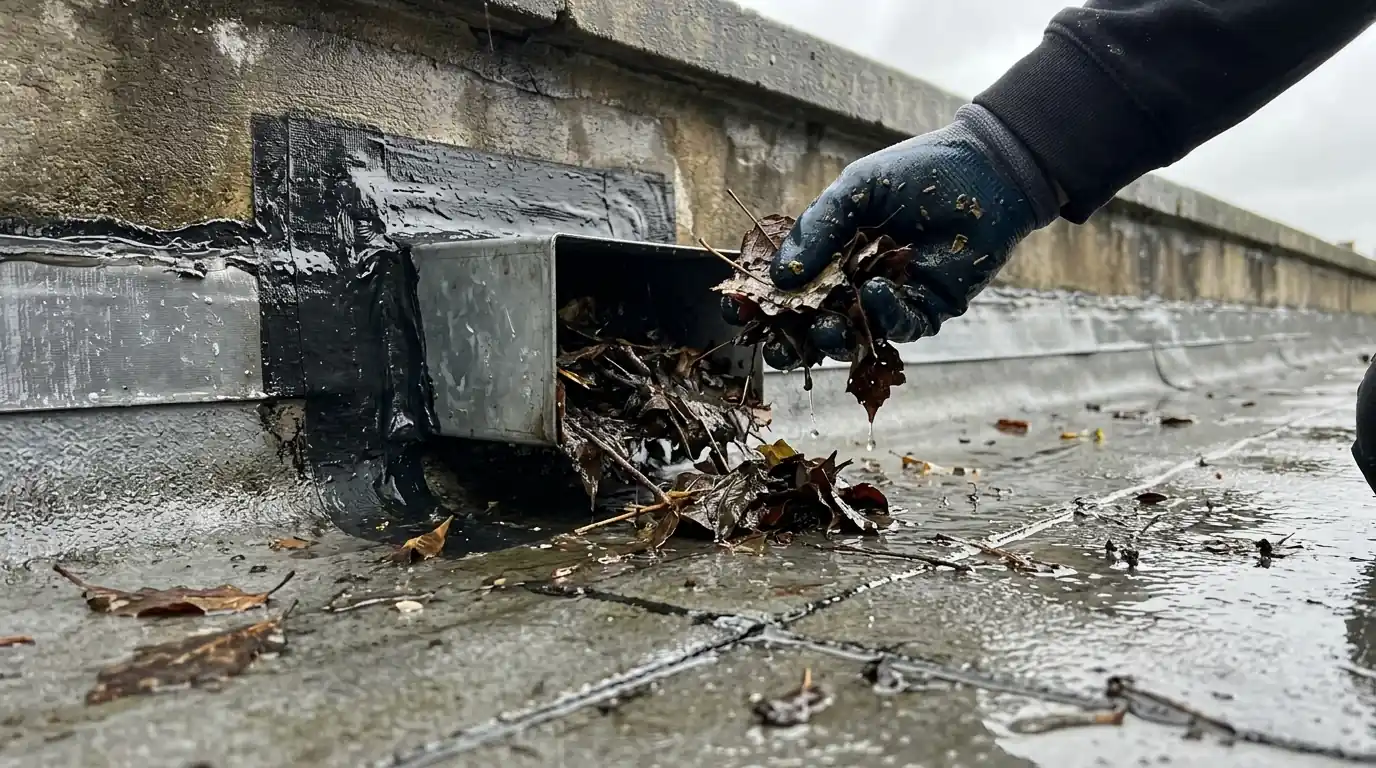
Water has to leave a flat roof through an outlet. Through-wall scuppers drain to a gutter or downspout, and interior drains carry water down through the building. When leaves, shingle granules or a tennis ball block that outlet, the whole roof turns into a basin.
We clear outlets, check the flashing around each scupper box and drain bowl, and confirm water leaves freely. Undersized or poorly placed scuppers get redesigned during larger repairs so the roof does not depend on a single opening.
Patching a rubber roof with asphalt mastic, or a TPO roof with the wrong primer, fails quickly and can make a proper repair harder later. We identify the membrane before we bring materials onto the roof.
EPDM repairs use compatible primer and seam tape or cured patches. TPO repairs are heat welded after the old surface is cleaned. Modified bitumen gets new cap sheet sections, torched or set in cold adhesive depending on what is safe near the building. Built-up roofs get layered repairs with matching asphalt and felt.
A flat roof with multiple leaks, saturated insulation underneath or widespread surface cracking may be past the point where patches make sense. Core samples tell us whether the layers below are wet. If they are, new material on top will trap the moisture.
In those cases we explain replacement options, from a new modified bitumen system on a porch to TPO or EPDM over an addition, or a coating if the roof is sound underneath. You get the photos and the reasoning before anything is decided.
Puddles that last two or more days after rain mean drainage or slope has failed.
Stains where a porch or addition meets the house often trace to failed wall flashing.
Blisters and spongy spots underfoot point to trapped moisture under the membrane.
A web of cracks on asphalt-based roofs means the surface has dried out.
Water spilling over the roof edge instead of through the scupper means the outlet is blocked.
Lifted seams or edge metal after wind open a direct path for water.
The same people who look at your roof are the ones who do the work, and they explain each step before it happens.
Call (405) 864-0080We confirm the membrane type and check for layers under it before choosing repair materials.
Our crew follows the water from the interior stain back to the actual entry point on the roof.
We clear outlets and correct low spots so the repaired area does not keep holding water.
Seams, blisters, flashing and edges are repaired using methods suited to that membrane.
Where practical we test the repair and share photos of the finished work.
Every roof is priced after we have seen it. These are the things that move the number up or down.
Call any hour. Our own crew inspects, photographs and explains the fix before any work starts.
Heavy rain overwhelms a partly blocked scupper or raises water above a weak seam or wall flashing. Light rain drains before it reaches the gap. We look at the outlet and the wall transition first.
No. Small, firm blisters are often stable and can be watched. Cutting one without drying and patching it properly invites water in.
Often, yes. If the insulation below is dry and the problems are local, targeted repairs can add years. Core samples tell us whether that makes sense.
Asphalt products do not bond well to EPDM and can damage it. Rubber roofs need compatible primer, seam tape or cured patches.
Yes. Detached garages, shop buildings, carports and small commercial roofs are regular flat roof repair jobs for our crews.
Torch-down, cold-applied and self-adhered modified bitumen for OKC porches, mid-century homes and small commercial roofs.
Learn moreBlack EPDM rubber roofs installed and repaired across OKC: taped seams, adhered or ballasted systems, and careful flashing details.
Learn moreWe trace a leak back to its true entry point, often feet away from the ceiling stain, and seal the real opening for good.
Learn moreLow-slope roof repair, replacement and surveys for OKC retail centers, offices, churches and warehouses, worked around your tenants.
Learn moreOklahoma City and the surrounding metro, including:
Gaillardia, Oklahoma CityBelle Isle, Oklahoma CityPutnam Heights, Oklahoma CityEarlywine, Oklahoma CityMidwest CityGuthrieNichols HillsCleveland CountyAll service areas