Hail Damage Roof Repair
Spring storms that build west of town regularly drop large hail across El Reno, bruising shingles and denting metal on homes and outbuildings.
Learn moreSapphire Roofing repairs and replaces roofs in El Reno, mostly after hail and high wind. We inspect the whole roof, photograph every hit, explain whether repair or replacement makes sense, and help you through the insurance claim process. Our own crews do the work, and we answer the phone 24/7, so call us as soon as a storm clears.
Answered 24/7Our own crews work in El Reno.
El Reno sits on the open prairie about 25 miles west of downtown Oklahoma City, where storms that build over western Oklahoma often reach full strength. The Canadian County seat has a long history with severe weather, and roofs here take more wind and hail than roofs in the middle of the metro.
We work El Reno from our south Oklahoma City office, running west on I-40 to the US 81 interchange. Most calls we answer here are hail bruising, shingles torn loose by straight-line wind, and older roofs that have finally lost the fight with years of open-country weather.
El Reno has seen more than its share of tornadoes. The May 24, 2011 El Reno to Piedmont tornado was rated EF5. On May 31, 2013, the El Reno tornado grew to 2.6 miles wide, the widest on record, and crossed US 81 south of town before turning northeast across I-40. It was officially rated EF3 and damaged the Canadian Valley Technology Center on Route 66.
On May 25, 2019, another EF3 tornado hit a motel and a mobile home park along US 81 inside the city. Most roofs never see a direct hit, but the same storm systems drop large hail and push straight-line winds across a much wider area than any tornado track.
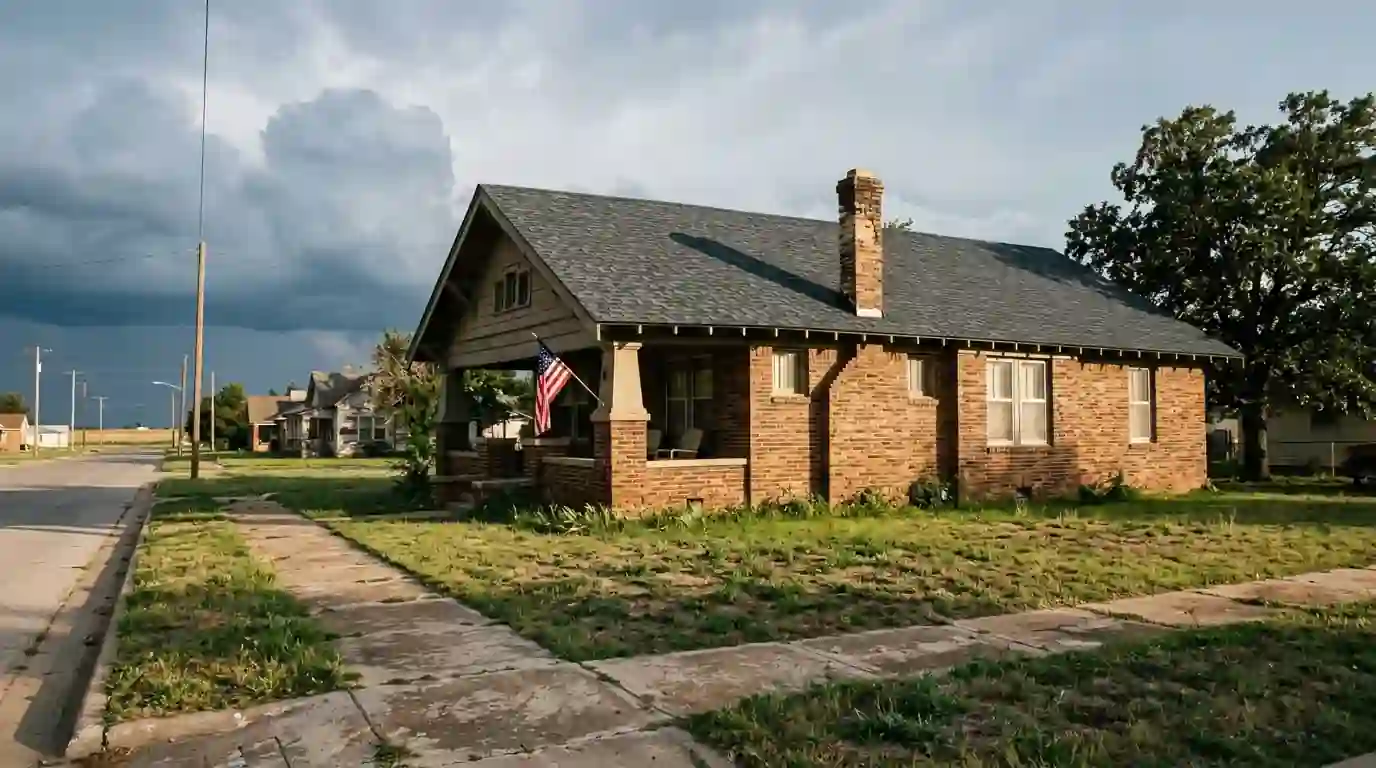
El Reno grew up after the 1889 land run, took its name from nearby Fort Reno, and became a Rock Island railroad town with a major terminal and repair yard until the railroad shut down around 1980. The older streets near downtown still hold early 1900s frame houses, bungalows and brick homes with steep gables, dormers and original chimneys.
Newer ranch homes and subdivisions spread out from the core, along with plenty of rural homes and metal shop buildings on acreage. That mix means we see three-tab shingles on older houses, architectural shingles on most newer ones, and exposed-fastener metal on barns and outbuildings.
With few tall trees or buildings to slow it down, wind in El Reno hits roof edges, ridges and rakes at full speed. We find creased shingles that lifted and dropped back flat, missing ridge caps, and drip edge pulled loose on the windward side. A creased shingle has lost its seal and will usually tear free in the next blow.
Older homes with steep roofs and dormers catch wind at every valley and wall joint, so flashing is a frequent problem. On rural properties, metal panels with loose or backed-out screws leak at every fastener, and we reseat or replace those fasteners as part of the repair.
Spring hail is the biggest reason El Reno homeowners call us. Hail leaves soft bruises in asphalt shingles, knocks granules into the gutters, and dents vents, flashing and metal panels. We mark and photograph hits on each slope so you and your adjuster can see exactly what the storm did.
Many Oklahoma policies carry a separate wind and hail deductible, often a percentage of your dwelling coverage, and some pay older roofs at actual cash value. We explain what we found and what the roof needs, then meet the adjuster on site if you want us there. We do not act as a public adjuster or negotiate your claim.
After a big storm, the first job is keeping water out. Our crews tarp open areas and torn slopes so rain cannot soak the decking or ceiling drywall while the claim is reviewed. We photograph the damage before the tarp goes on.
When replacement is the right call, many El Reno owners choose Class 4 impact-resistant shingles or stone-coated steel because of how often hail returns here. We walk through the tradeoffs in weight, look and cost drivers, and let you decide.
Spring storms that build west of town regularly drop large hail across El Reno, bruising shingles and denting metal on homes and outbuildings.
Learn moreOpen prairie lets straight-line winds hit roof edges and ridges at full force, so lifted shingles and missing ridge caps are common here.
Learn moreAfter severe storms, a tarp keeps rain off exposed decking while the insurance claim and the permanent repair are lined up.
Learn moreOwners tired of repeat hail claims often move to Class 4 shingles when a storm-damaged roof has to come off.
Learn moreMost major roof work in El Reno follows a storm, so we photograph damage and explain the claim process step by step.
Learn moreCall Sapphire. Our own roofers inspect, photograph and fix the problem, and we explain it first.
Yes. We come out from our south Oklahoma City office along I-40, inspect the roof, and photograph the damage on every slope. If the roof is open, we tarp it first so the house stays dry.
Yes. Hail bruises often cannot be seen from the ground, especially on lighter shingles. The signs show up up close: soft spots in the mat, missing granules and small dents in vents and flashing.
We do. On rural properties we often reseat or replace backed-out fasteners, replace dented or torn panels, and reseal ridge and trim pieces that wind has loosened.
Class 4 impact-resistant shingles and stone-coated steel both handle hail better than standard shingles, and proper nailing and edge metal matter as much as the product. We explain the options and what drives cost for each before you choose.