Commercial Roofing
Low-slope roof repair, replacement and surveys for OKC retail centers, offices, churches and warehouses, worked around your tenants.
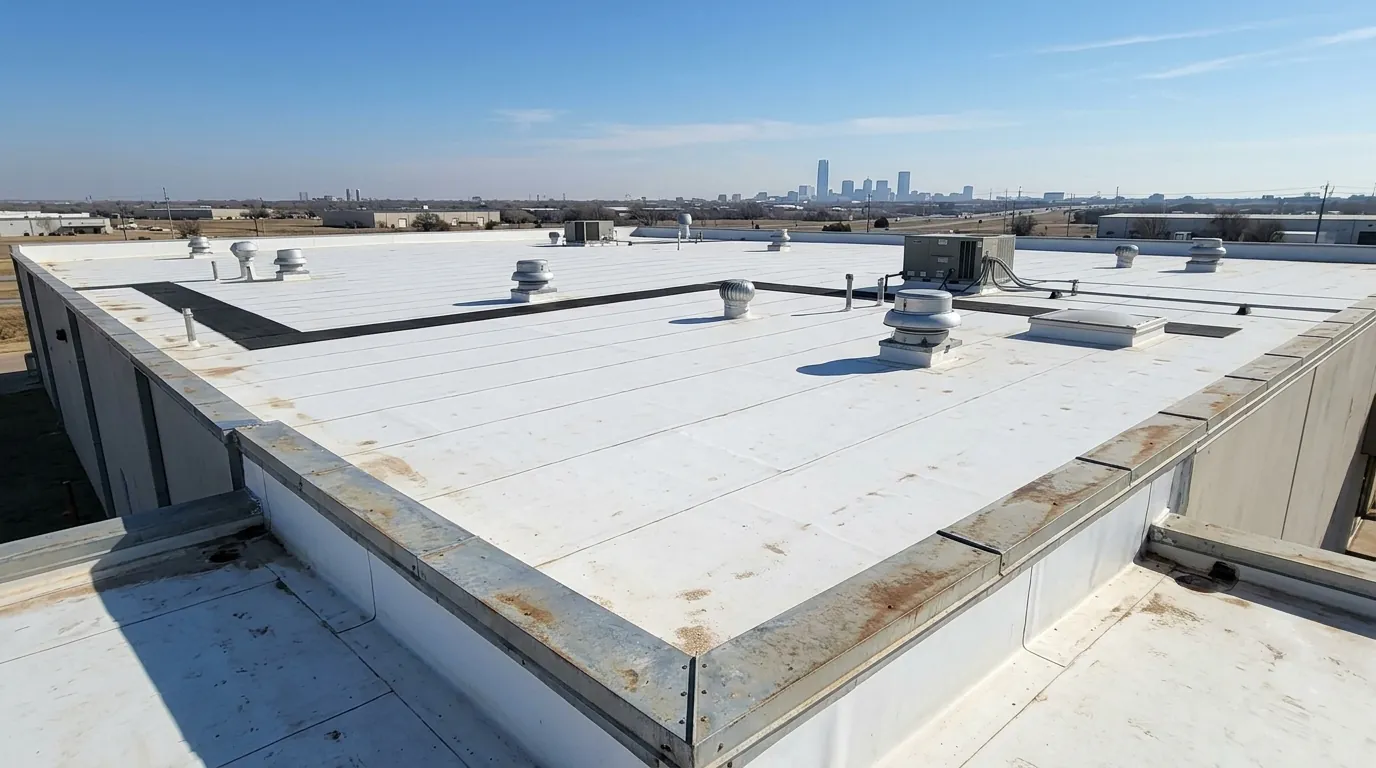
Learn moreDrive past newer warehouses, medical offices and retail buildings around the metro and many of the roofs you can see from a highway overpass are bright white. Most of those are TPO, short for thermoplastic polyolefin. It has become one of the most common low-slope roofing choices in the country.
Answered 24/7Call (405) 864-0080 and talk to Sapphire.
TPO is a white single-ply roofing membrane used on low-slope roofs. Its seams are joined with hot air into one continuous sheet, and its reflective surface keeps the roof cooler in Oklahoma City summers. It can be mechanically attached or fully adhered over insulation. Sapphire installs and repairs TPO on commercial buildings, additions and flat-roofed homes across the metro.
Sapphire installs TPO on commercial buildings, churches, shops and residential low-slope sections such as additions, porches and flat-roofed modern homes. Our own crews handle the tear-off, insulation, membrane, welding and flashing, and we repair existing TPO roofs that were installed by others.
TPO is a flexible sheet that arrives on the job in large rolls. The top surface is usually white, though tan and gray exist. The sheet has a reinforcing scrim in the middle, which gives it strength and keeps it from stretching under foot traffic and wind.
The white surface reflects a large share of the sun's energy instead of soaking it up. On a central Oklahoma afternoon a dark roof can get far hotter than a white one in the same sun. A cooler surface means less heat driven into the building below and less thermal stress on the roof itself.
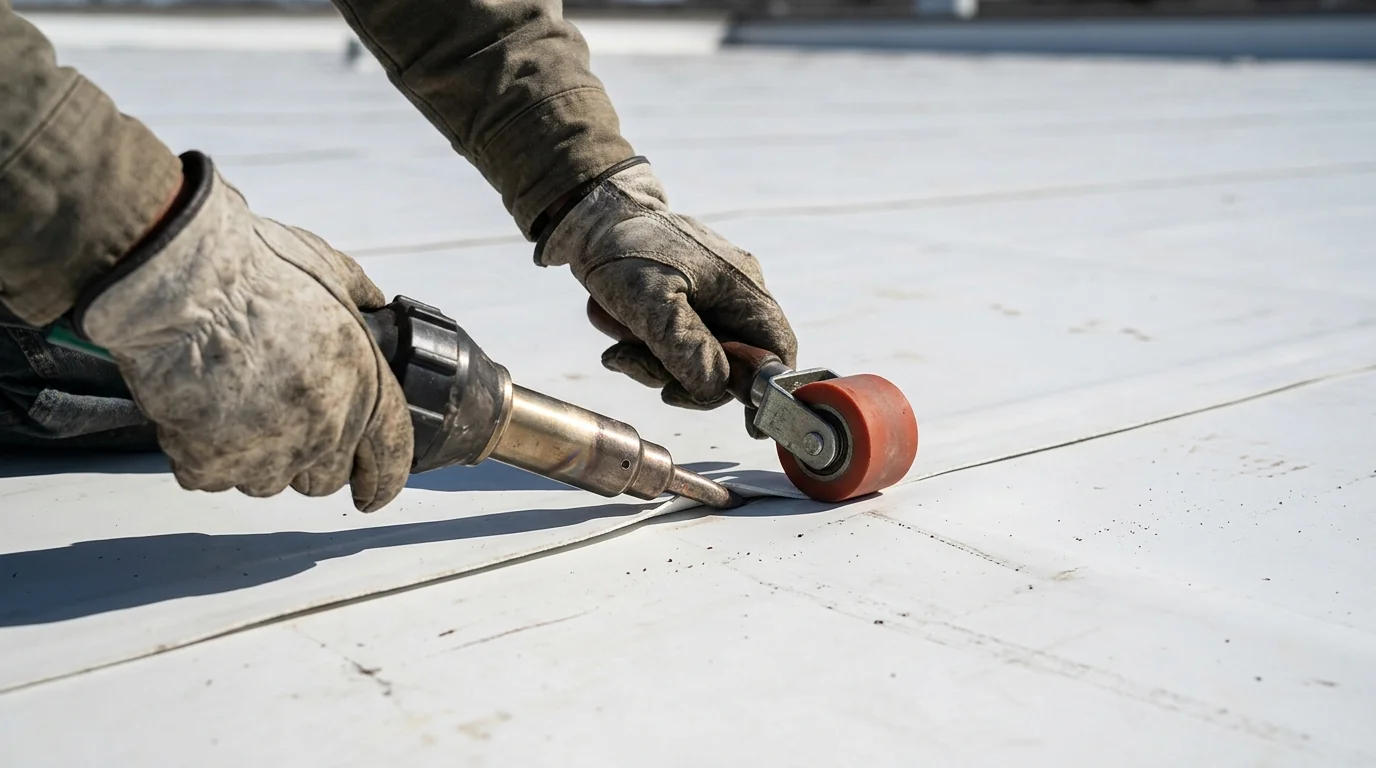
The feature that sets TPO apart from rubber roofs is how the sheets join. Where two sheets overlap, a robotic or hand-held hot-air welder melts the two layers together. Once cooled, the seam is one continuous piece of plastic, not two pieces glued or taped.
Weld quality depends on temperature, speed, cleanliness and the weather that day. Our crews run test welds at the start of each day and whenever conditions change, then probe finished seams with a seam probe to catch any spots that did not fuse. A good weld is often stronger than the sheet around it.
TPO can be held down two main ways. Mechanically attached systems fasten the membrane through the insulation into the deck with screws and plates along the seams, and the next sheet covers those fasteners. It is fast and works well on steel decks common on warehouses.
Fully adhered systems glue the membrane to the insulation board across its whole surface. They resist wind flutter better, look smoother and suit roofs with lots of penetrations or odd shapes. The right choice depends on the deck type, the building's wind exposure and what the roof is covering.
The insulation under a TPO roof does more than save energy. Tapered insulation can create slope where the deck is flat, pushing water toward drains and scuppers. Crickets built behind rooftop units and along parapets keep water from pooling where it would sit against flashing.
A cover board on top of the insulation gives the membrane a firm surface. That helps with hail resistance and foot traffic, both real concerns on Oklahoma roofs where HVAC technicians are up several times a year and spring storms can bring large hail.
Most leaks on any membrane roof happen at the details, not in the open field. On TPO, parapet walls, curbs, pipes and drains are flashed with the same membrane material and welded to the field sheet, so the whole roof shares one material.
Pre-molded corners and pipe boots handle common shapes. Coated metal edge pieces let the membrane weld directly to the drip edge or gravel stop. We pay close attention to inside and outside corners, where hand welding takes the most skill and where shortcuts show up first.
TPO repairs follow the same welding logic, but older membrane needs preparation. Weathered TPO picks up dirt and oxidation, so we clean the area with a dedicated cleaner before welding a patch. A patch welded onto a dirty sheet will peel.
Common repairs include punctures from dropped tools, split seams on early-generation TPO, hail fractures on aging sheets, and failed flashings at units added after the roof was installed. If a TPO roof is near the end of its life, we discuss whether a silicone coating or a recover makes more sense than ongoing patches.
TPO is not only for commercial buildings. Modern homes with flat roofs, sunroom additions and porch roofs tied into a pitched shingle roof can all use it. Its light color and welded seams suit low-slope residential sections well.
On homes we focus on the transitions, where the TPO meets siding, brick or shingles. Those spots need membrane turned up the wall, proper counter-flashing and attention to how water from the main roof lands on the low section.
Seams you can lift with a fingertip or that look wrinkled at the edge need to be rewelded.
Small holes around HVAC units often come from dropped tools or panel screws.
An aged sheet that looks chalky or shows surface cracking is losing its top layer.
Billowing on a mechanically attached roof can mean loose fasteners or air leaks at the edge.
Water inside near walls often points to failed wall flashing or termination bar.
Large hail can fracture older TPO, especially over soft insulation without a cover board.
The same people who look at your roof are the ones who do the work, and they explain each step before it happens.
Call (405) 864-0080We check the deck type, existing layers, insulation condition and drainage before designing the system.
We recommend mechanically attached or fully adhered based on the deck, wind exposure and building use.
Tapered insulation and a cover board go down to set slope and give the membrane a firm base.
Our crew rolls out the sheets, test welds daily and probes every finished seam.
Walls, curbs, pipes and edges are flashed with TPO and welded to the field before final inspection.
Every roof is priced after we have seen it. These are the things that move the number up or down.
Call any hour. Our own crew inspects, photographs and explains the fix before any work starts.
A reflective roof keeps the surface cooler, which reduces heat flowing into the building in summer. How much that shows up on a bill depends on insulation and the building's use.
Sometimes. If the existing roof is dry, sound and there is only one layer, a recover with new insulation and TPO can work. Core samples tell us whether that is safe.
Newer, thicker TPO over a firm cover board resists hail better than thin sheets over soft insulation. Aging membrane is more likely to crack, so condition matters as much as material.
TPO is usually white with heat-welded seams. EPDM is usually black rubber with taped or glued seams. Both work on low-slope roofs; the right one depends on the building.
Yes. TPO works well on low-slope residential sections, as long as the transitions to siding, brick or shingles are flashed correctly.
Low-slope roof repair, replacement and surveys for OKC retail centers, offices, churches and warehouses, worked around your tenants.
Learn moreBlack EPDM rubber roofs installed and repaired across OKC: taped seams, adhered or ballasted systems, and careful flashing details.
Learn moreSilicone coatings that restore sound low-slope roofs in the OKC metro, after a moisture survey, careful cleaning and proper prep.
Learn moreRepairs for flat and low-slope roofs on OKC homes, porches, additions and small shops: ponding, blisters, seams, scuppers and drains.
Learn moreOklahoma City and the surrounding metro, including:
Lake Hefner, Oklahoma CityHeritage Hills, Oklahoma CitySouthern Hills, Oklahoma CityNormanDel CityPiedmontShawneeMcClain CountyAll service areas