Shingle Repair
Replacing cracked, curled or missing shingles with the closest match available, worked into the old roof without breaking it.
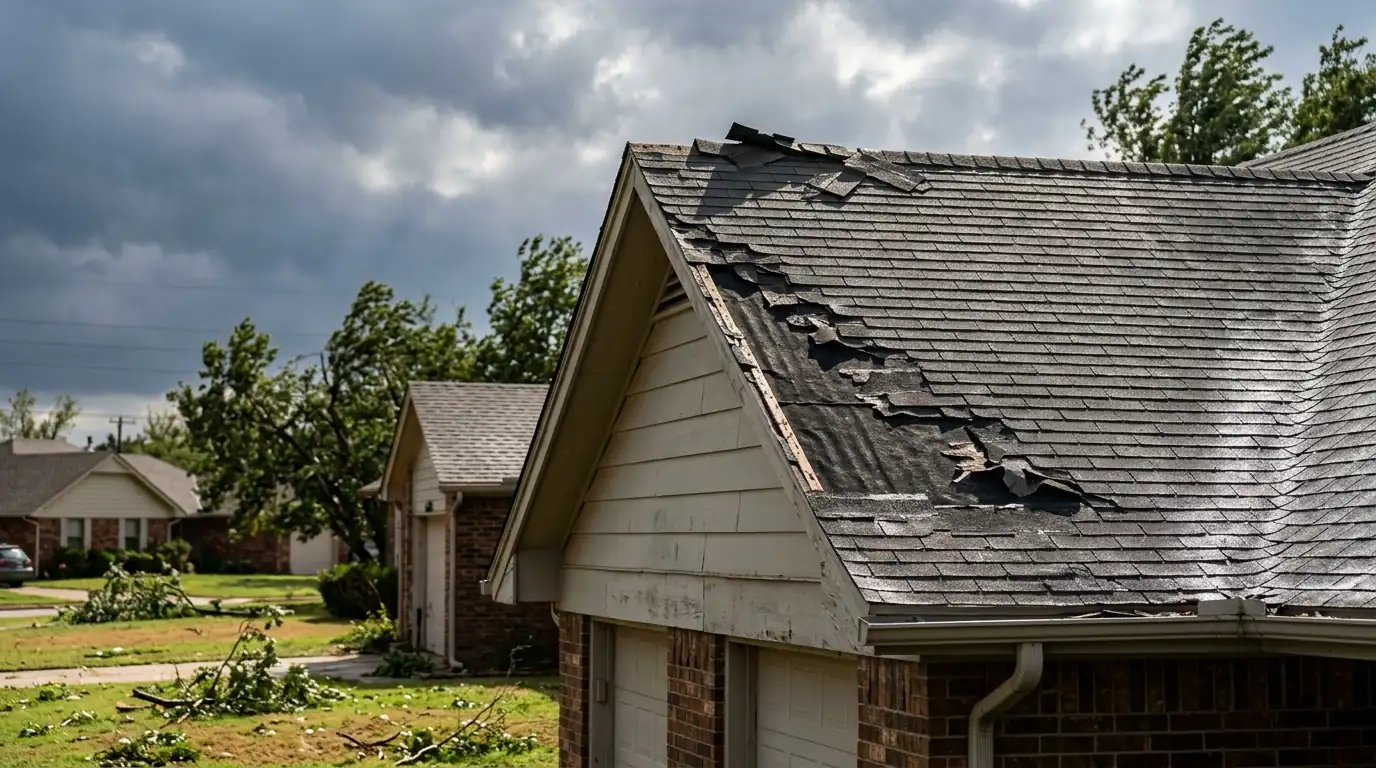
Learn moreIn central Oklahoma, the wind that does the most roof damage often isn't a tornado. It's straight-line wind pushed out ahead of a line of thunderstorms, with gusts that can run well past highway speed for minutes at a time. Those gusts hit whole neighborhoods at once, and the damage is easy to miss from the ground.
Answered 24/7Call (405) 864-0080 and talk to Sapphire.
Wind damage starts when gusts break the adhesive seal under a shingle and lift the tab, which creases or tears it even if it lays back down. Sapphire checks for creases, unsealed tabs, blow-offs and torn ridge cap, looks at the nailing pattern that held them, and replaces damaged shingles so they reseal and stay put.
Sapphire's crews inspect wind damage shingle by shingle, because a tab that flapped and settled back down can look normal from the yard while its seal and its mat are already broken.
Every asphalt shingle has a strip of adhesive along its underside that bonds to the shingle below once the sun warms it. That bond is what holds the tab flat in a gust. When wind works under the edge and breaks the seal, the tab is free to lift and slap down with every gust after that.
Each time a tab bends upward past its limit, the mat creases across the shingle, usually in a straight line near the nail row. A creased shingle has lost strength and its seal. It will tear off in the next storm or let wind-driven rain slide underneath.
Missing shingles and bare spots are the obvious signs, but they're often a small part of the total. On a wind-damaged roof we usually find many more tabs that are still in place but unsealed or creased, especially along the rakes, eaves and ridge where wind pressure is strongest.
We check by lifting tabs gently along each slope to test the seal and look for crease lines. On a big roof that takes time, but it's the only way to count the real damage. Torn ridge cap, lifted starter strips at the eaves and peeled-back drip edge also tell us the roof took a real beating.
How a shingle was nailed decides how well it holds. Manufacturers specify a nail zone, a count per shingle and a pattern for high-wind areas. Nails driven too high miss the overlap of the shingle below, and nails that are overdriven or angled cut through the mat and leave less to hold onto.
When shingles blow off in clean sheets with nails still sitting in the decking, it often points back to an installation problem rather than an extreme gust. We photograph the nail placement we find so you know whether the issue was the storm, the original install or both.
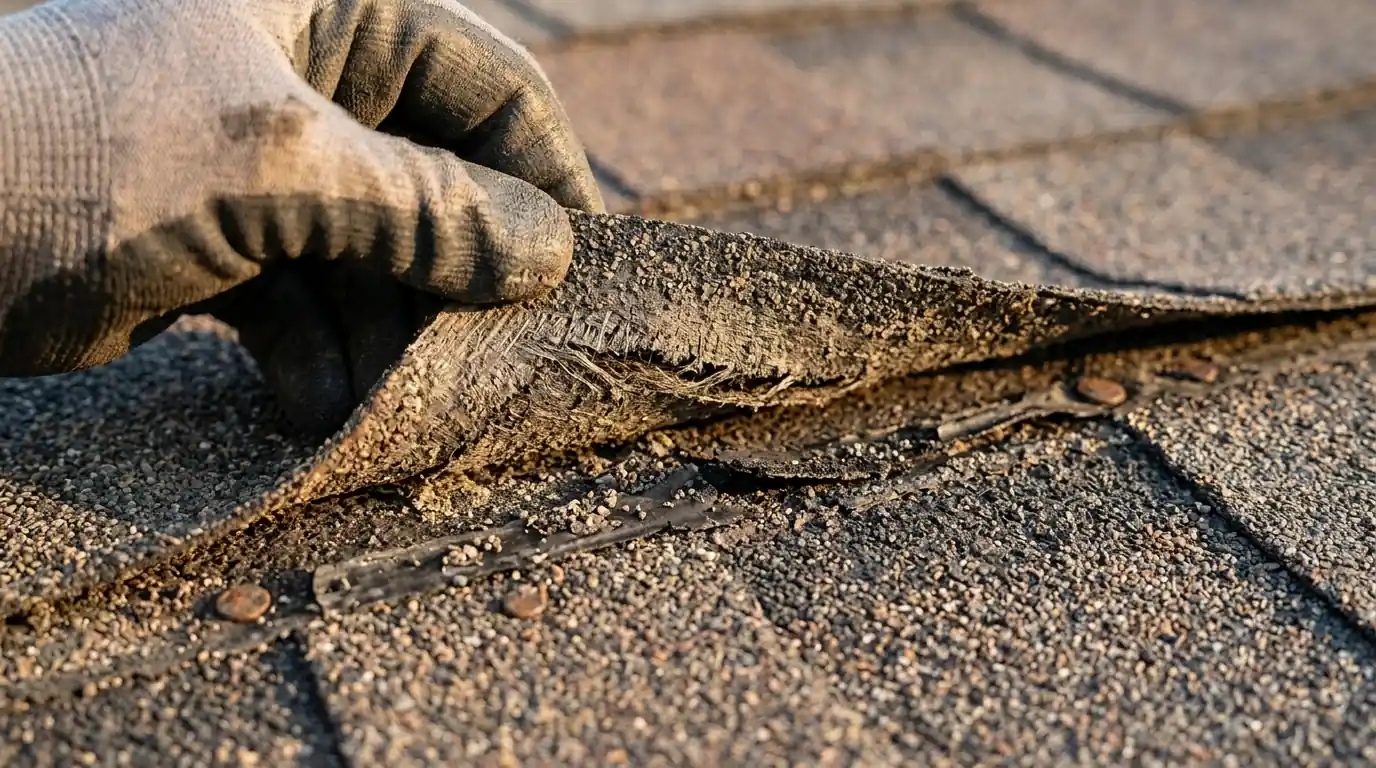
A creased shingle can't be fixed by gluing it down, so we replace it. That means breaking the seal on the courses above, removing the damaged piece and its nails, sliding in a new shingle, nailing it in the proper zone, and resealing the tabs above and below it.
Some unsealed but uncreased tabs can be hand-sealed with a manufacturer-approved adhesive. We only do that where the shingle itself is still sound. Ridge cap, starter strip and drip edge get replaced and refastened so the edges of the roof stop catching wind.
Wind pressure isn't even across a roof. Uplift is highest at the corners, the rakes on the gable ends, the eaves and the ridge line. That's where shingles get unsealed first and where blow-offs usually start before spreading inward.
Homes on open lots, at the edge of a subdivision or on higher ground take more wind than homes sheltered by trees and neighbors. Across the open stretches around OKC, we see that pattern clearly: the house facing the open field loses shingles, the one behind it loses fewer.
Seal strips need warmth to bond. A roof installed in a cold month may not fully seal until spring warms it up, leaving it more vulnerable to early-season wind. On the other end, very old shingles can lose the tackiness in their adhesive over years of baking under the Oklahoma sun.
If we find large areas of unsealed tabs without creasing, we'll tell you whether hand sealing makes sense or whether the shingles are at the age where the seal won't hold again. That answer decides between a repair and a replacement, and we'll show you the tabs that led us there.
Whole shingles or tab pieces on the ground after a windstorm mean there are bare spots up top.
Hearing a slap or flutter on the roof during wind usually means unsealed tabs.
Straight horizontal marks on shingles near the ridge or edges are wind creases.
Gaps along the peak leave the ridge vent or decking edge open to rain.
Black or gray felt showing through means the shingle layer above it is gone.
Metal edging that's bent out or hanging lets wind get under the first course.
The same people who look at your roof are the ones who do the work, and they explain each step before it happens.
Call (405) 864-0080We start at rakes, eaves and ridge where uplift is strongest and damage usually begins.
Tabs are gently lifted across each slope to check for broken seals and creasing.
We look at nail placement and count to see why shingles failed.
You get photos of creases, blow-offs and nailing with a plain read on repair versus replacement.
Our crew swaps damaged shingles, refastens edges and seals tabs so they hold in the next blow.
Every roof is priced after we have seen it. These are the things that move the number up or down.
Call any hour. Our own crew inspects, photographs and explains the fix before any work starts.
It varies by shingle age, rating and installation. Older shingles with weak seals can lift in gusts that newer roofs shrug off. After any storm with strong gusts, a close inspection is the only way to know.
Only if they aren't creased. A creased shingle has a broken mat and has to be replaced. Uncreased tabs with failed seals can sometimes be hand-sealed with an approved adhesive.
Wind is a commonly covered peril, but many Oklahoma policies have a separate wind and hail deductible. Check your declarations page. We document the damage with photos so you have what you need to decide whether to file.
Wind hits the slopes facing the storm and the edges hardest, and open lots catch more wind than sheltered ones. Nailing differences between installers or repairs can also make one area weaker.
We look at nail placement on the shingles that failed. High or overdriven nails and missing fasteners point to the install, while torn shingles with correct nailing point to the wind. Often it's a mix of both.
Replacing cracked, curled or missing shingles with the closest match available, worked into the old roof without breaking it.
Learn moreTargeted fixes for missing shingles, worn flashing, cracked pipe boots and small leaks, done by Sapphire's own crews across OKC.
Learn moreRoof inspections in Oklahoma City covering shingles, flashing, attic and decking, with photos and a plain-language report.
Learn moreThree-tab, architectural and designer asphalt shingles installed in Oklahoma City with correct nailing and wind-rated starter.
Learn moreOklahoma City and the surrounding metro, including:
Gatewood, Oklahoma CityWestmoore, Oklahoma CityYukonChoctawThe VillageCanadian CountyLansbrook, Oklahoma CityCrown Heights, Oklahoma CityAll service areas