Seamless Gutters
Seamless gutters rolled on site, sized for Oklahoma downpours, with downspouts placed to keep water off your foundation.
Learn moreMost gutters don't fail all at once. A spike works loose, a corner seam starts dripping, a section sags just enough that water pools in the middle, and over a few seasons that standing water soaks into the fascia behind it. By the time anyone notices, the board holding the gutter up may be soft.
Answered 24/7Call (405) 864-0080 and talk to Sapphire.
Gutter repair fixes the parts of a gutter system that have failed without replacing every run. The most common OKC repairs are rehanging sagging sections with screwed hangers, resealing leaking seams and end caps, correcting pitch so water reaches the downspouts, and replacing rotted fascia board behind the gutter. If more than a few runs are failing, replacement may cost less over time.
Sapphire repairs gutters across the Oklahoma City metro, from 1950s ranch homes in Del City and Midwest City to newer builds in south OKC near our Santa Fe Avenue office. We fix what's broken, show you photos of what we found behind the gutter, and tell you plainly when a system is worth repairing and when it isn't.
Older gutters were often hung with spikes driven through a sleeve called a ferrule into the fascia. Every hot summer and cold winter, the wood expands and shrinks around that spike, and over years it walks out. Once a few spikes let go, the run sags, holds water, and gets heavier, which pulls the next spikes loose.
We replace spikes with hidden hangers fastened by long screws, driven through the fascia into the rafter tails where we can reach them. Spacing them closer together, especially near downspouts and below valleys where water is heaviest, keeps the run from bowing again.
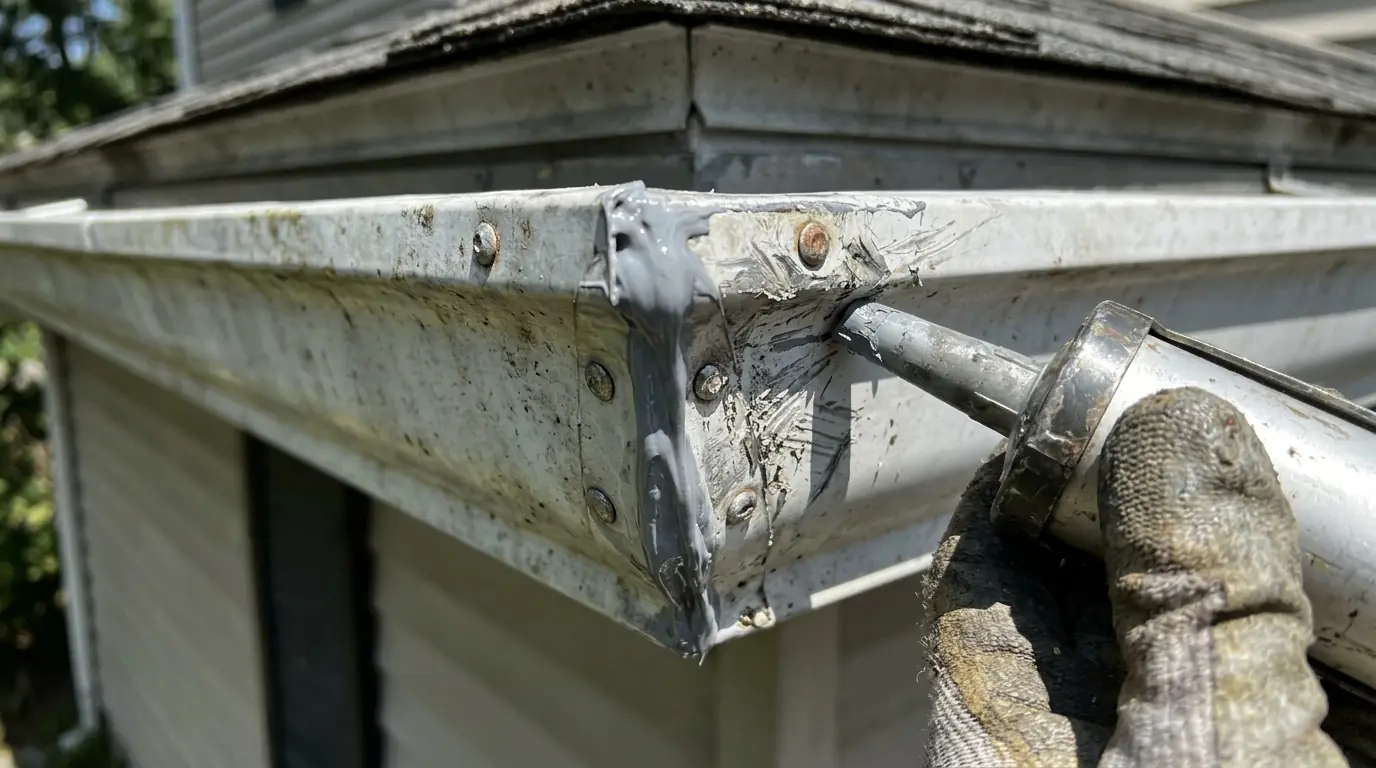
Even seamless gutters have joints at the inside and outside corners, the end caps and the downspout outlets. The sealant at those joints dries out in summer attic-edge heat and cracks in winter. Sectional gutters add a joint every 10 feet, so they leak in more places.
A proper reseal isn't just a fresh bead over old caulk. We cut out the old sealant, clean the metal down to bare surface, rivet any loose joint tight, and then apply a gutter sealant made to flex with the metal. Where an end cap is bent or split, we replace it rather than smearing more sealant on top.
A gutter should slope gently toward its outlet, about a quarter inch for every 10 feet of run. When a run is hung dead level, or sags in the middle, water sits in it after every storm. Standing water breeds mosquitoes in Oklahoma summers, feeds rust in steel gutters, and adds weight in winter when it freezes.
We check pitch with a level and a hose. On long runs over about 35 or 40 feet, we may split the slope so it falls both ways to two downspouts. Re-pitching usually means taking the run down, setting a chalk line on the fascia and rehanging it on new hangers.
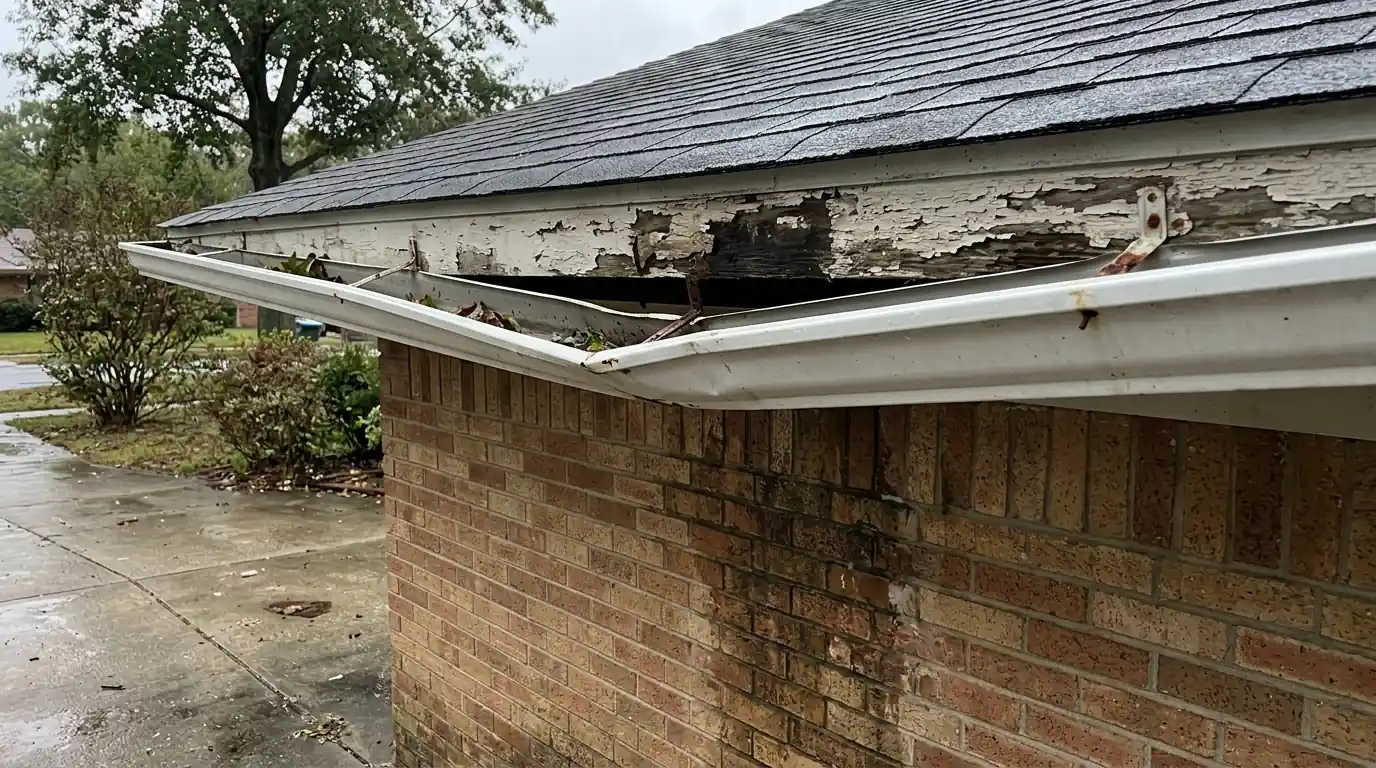
The fascia board is the trim at the end of the rafters that your gutter hangs on. When a gutter overflows or leaks at the back, water runs down that board every storm. Pine fascia on many OKC homes from the 1960s through the 1990s softens, the paint peels, and eventually screws won't hold.
We probe the fascia with an awl wherever a gutter has been sagging or leaking. Soft sections get cut out and replaced with new board, primed on all sides, and often wrapped in aluminum trim coil so the wood isn't exposed again. Then the gutter goes back on solid backing.
A run with one loose section, one leaking corner or a crushed downspout is a clear repair. If most of the system is sectional, the seams are leaking in many places, or hail has dented the face of most runs, you'll likely spend more chasing leaks year after year than you would on new seamless gutters.
We also look at size. If gutters are 5-inch with 2x3 downspouts and they overflow every hard rain even when clean, repairs won't fix the problem. In that case we'll show you where the water is going and explain what an upgrade would change.
Many gutter leaks are really downspout problems. A crushed elbow from a lawn mower, a downspout bracket pulled off brick, or an outlet clogged with granules and sweetgum balls backs water up into the gutter until it spills out somewhere else.
We clear and rehang downspouts, replace crushed elbows, add extensions so water leaves the foundation zone, and add a second outlet on runs that have only one for a large roof area. Moving water away from the house matters on Oklahoma red clay, which swells and shifts as it gets wet.
A gap between the gutter and fascia, or a run tilting outward, means hangers have loosened or the wood is rotting.
Puddles in the gutter a day after a storm show the pitch is off or the run has sagged.
Leaks at corners and end caps during rain mean the sealant joint has failed.
Blistered or peeling paint right behind the gutter is often the first sign of water rot.
Dark streaks down brick or siding below the gutter show where water is escaping.
Flattened or disconnected downspouts back water up and spill it beside the foundation.
The same people who look at your roof are the ones who do the work, and they explain each step before it happens.
Call (405) 864-0080We check hangers, seams, pitch, downspouts and the fascia behind every run, and photograph what we find.
You get a clear list of what needs fixing and our honest view on whether repair makes sense.
Any rotted board is cut out and replaced so the gutter has solid backing.
We install screwed hangers, rebuild leaking joints and set the correct slope toward each outlet.
We run a hose through every repaired run and confirm water leaves each downspout cleanly.
Every roof is priced after we have seen it. These are the things that move the number up or down.
Call any hour. Our own crew inspects, photographs and explains the fix before any work starts.
Spike-and-ferrule hangers loosen as the fascia wood swells and shrinks through hot summers and cold winters. Once a few let go, the run holds water and sags further. Rehanging with screwed hidden hangers at closer spacing usually fixes it.
Yes, most corner leaks are repairable. We remove the old sealant, clean the metal, rivet the joint tight and reseal it with a flexible gutter sealant. If the corner piece is split or badly bent, we replace just that piece.
Look for peeling paint, dark staining or soft spots right behind the gutter line. From a ladder, a screwdriver will sink into rotten wood easily. We probe and photograph the fascia during every gutter repair so you can see what's there.
About a quarter inch of fall for every 10 feet of run, toward the downspout. Very long runs are often split to slope both ways toward two downspouts so water doesn't have to travel the whole length.
When most of the system is leaking, badly dented from hail, or too small to handle the roof's runoff even when clean. In those cases, new seamless gutters usually cost less than repeated repairs over the next several years.
Seamless gutters rolled on site, sized for Oklahoma downpours, with downspouts placed to keep water off your foundation.
Learn moreSoffit and fascia repair for rot, squirrel and bird entry, and blocked attic intake vents, finished in aluminum wrap.
Learn moreGutter guards chosen for the debris your trees actually drop, from oak and elm leaves to pine needles and cottonwood fluff.
Learn moreWe trace a leak back to its true entry point, often feet away from the ceiling stain, and seal the real opening for good.
Learn moreOklahoma City and the surrounding metro, including:
BethanyWarr AcresOklahoma CountyQuail Creek, Oklahoma CityWindsor Hills, Oklahoma CityEdgemere Park, Oklahoma CitySouthern Oaks, Oklahoma CityMooreAll service areas