Roof Replacement
Many Del City roofs went on during the same rebuild years after 1999 and are now wearing out together.
Learn moreSapphire Roofing repairs and replaces roofs throughout Del City with our own crews, coming from our south Oklahoma City office just a few miles west. Del City is mostly post-war ranch homes with low-pitch roofs, so we see a lot of worn shingles, tired decking, flashing leaks around old chimneys and storm damage. Call us any hour for an inspection with photos.
Answered 24/7Our own crews work in Del City.
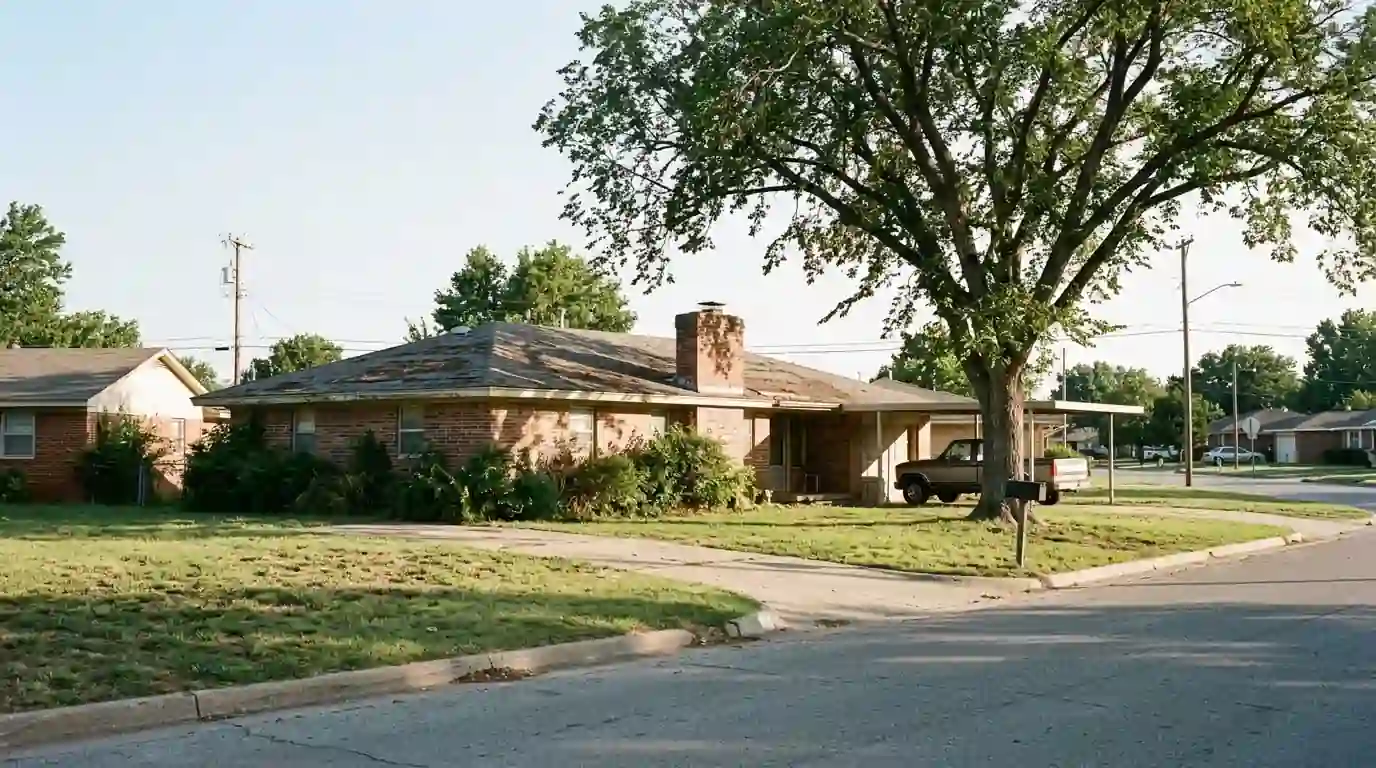
Del City grew almost overnight after World War II, next door to what is now Tinker Air Force Base, and most of its roofs sit on compact ranch homes from that first building wave and the decades right after it. Those houses were built to be practical, and many of them are now on their second, third or even fourth roof.
That history shapes what we find on Del City jobs. Under a newer layer of shingles there may be original plank decking, flashing that has been reused more than once, or an extra roof layer that was never torn off. Our crews inspect what's actually up there, photograph it, and give you a straight explanation before any work starts.
Del City began in 1946 when developer George Epperly bought a 160-acre wheat field near SE 29th Street and Sunnylane Road with plans for fifty houses. By 1948 there were 582 homes, most of them his, and residents of what was then called Epperly Heights voted to incorporate that October. The city takes its name from his eldest daughter, Delaphene.
The population climbed fast through the 1950s and 1960s, as Tinker became the largest single-site employer in the state and families wanted homes close to the base. Del City annexed Carter Park in 1954 and Midway Village in 1963, so the housing stock runs from late-1940s cottages to 1960s and 1970s brick ranches.
The typical Del City roof is a simple hip or gable over a one-story house, often with a fairly low pitch. Low slopes drain slower, so a lifted shingle or a cracked pipe boot leaks sooner than it would on a steep roof. Valleys over attached carports and garage additions are another weak point, especially where an addition was tied in later.
Older homes here sometimes have plank or thin sheathing, and on reroofs we regularly find soft spots near the eaves from years of gutter overflow. We photograph every damaged area once the old shingles are off, so you know exactly which sheets were replaced and why.
The Bridge Creek and Moore F5 tornado of May 3, 1999 tore across a large part of Del City, entering near SE 44th Street and Spiva Drive and leaving near Sooner Road and Woodview Drive. Seven Del City residents died, and a memorial on Sooner Road honors them. Many homes along that path were rebuilt or reroofed afterward.
That means a lot of Del City roofs date from the same rebuild years and are now aging out together. Beyond tornadoes, the city sees the same spring hail and straight-line winds as the rest of the metro, and Interstate 40 running through town is a reminder of how open the ground is to the east and west.
Plenty of post-war Del City homes still have brick chimneys, and a lot of the leaks we chase come from step and counter flashing around them that has pulled loose or been sealed over with roofing cement instead of being replaced. Fixing it properly means removing shingles around the chimney and installing new flashing that's cut into the mortar.
Flat or nearly flat carport roofs and back-porch additions are common too. Those low-slope sections need a membrane or a properly lapped roll roofing system rather than shingles, and we often find them covered in shingles that were never meant for that pitch.
Del City is one of the shortest drives from our south Oklahoma City office, roughly a straight shot east. That makes it easy to get a crew out the same day to tarp a storm-damaged roof or to look at a leak while it's still dripping, which is the best time to trace it.
We work all over town, from the neighborhoods around Eagle Lake on the north side down to the streets near SE 44th Street. Whatever the job, the same crew that inspects your roof does the work, and you see the photos before and after.
Many Del City roofs went on during the same rebuild years after 1999 and are now wearing out together.
Learn moreOlder brick chimneys and patched-over flashing are the most common source of the leaks we trace in Del City ranch homes.
Learn morePost-war homes often have plank or thin sheathing that has gone soft at the eaves after years of small leaks.
Learn moreCarports and back-porch additions on Del City houses are often low-slope sections that were shingled when they needed a membrane.
Learn moreDel City sits in the same spring hail corridor as the rest of the metro, and low-pitch roofs show hail damage quickly.
Learn moreCall Sapphire. Our own roofers inspect, photograph and fix the problem, and we explain it first.
Some older Del City homes do, because an earlier reroof went over the top instead of tearing off. We check at the eaves and in the attic during the inspection. When we replace a roof, we tear off every layer down to the deck so we can inspect and repair the sheathing.
Usually the step and counter flashing has failed or was sealed over with roofing cement that has cracked. We remove the shingles around the chimney, install new flashing cut into the mortar joints, and reshingle the area so it sheds water properly.
Yes. Low-slope carport and porch roofs need a membrane such as modified bitumen or TPO, not shingles. We'll explain which fits your structure and tie it into the main roof so water doesn't back up at the joint.
We answer 24/7, and Del City is a short drive from our south Oklahoma City office, so we can usually get a tarp on the same day. We photograph the damage before tarping so you have a record for your insurance company.