TPO Roofing
White TPO single-ply roofs for OKC commercial buildings and low-slope homes, heat-welded seams, attached or adhered to suit the deck.
Learn moreA commercial roof is out of sight for most of the people who depend on it. Tenants notice it when a ceiling tile drops into a sales floor, a church notices when water drips onto the sanctuary carpet before Sunday service, and a warehouse notices when a pallet of stock gets soaked. By then, the problem has usually been building for a while.
Answered 24/7Call (405) 864-0080 and talk to Sapphire.
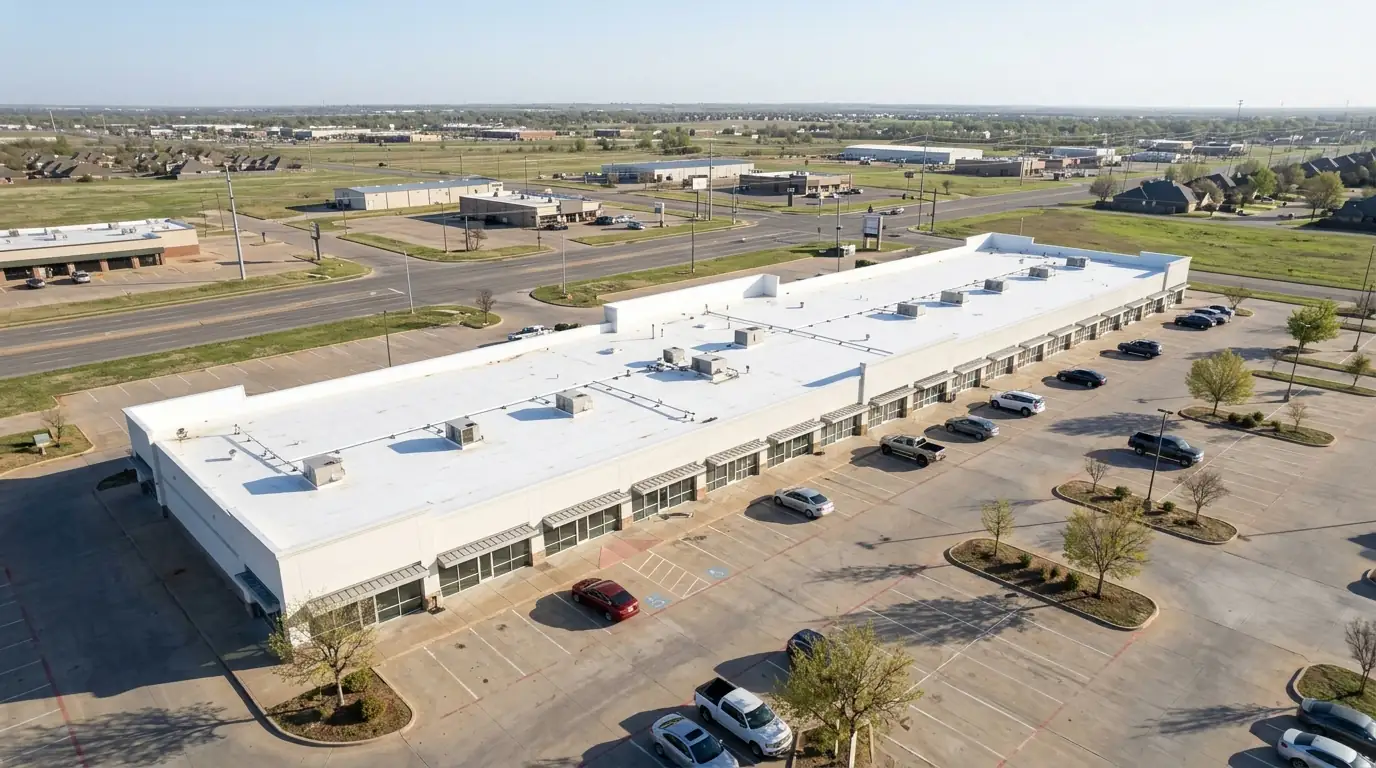
Commercial roofing covers the low-slope systems on retail centers, offices, churches and warehouses: TPO, EPDM, modified bitumen, built-up roofs and coatings. In Oklahoma City, the work usually starts with a roof survey to map leaks, ponding and wet insulation. Sapphire then repairs, restores or replaces the system while keeping tenants and congregations working underneath.
Sapphire works on light commercial buildings across the metro: strip centers along the major arterials, single-story office buildings, churches, small warehouses and shop buildings. Our own crews handle surveys, leak repairs, restorations and full replacements on the common low-slope systems, and we plan each job around the people inside.
Most commercial roofs in the OKC area are low-slope, meaning they look flat but are built with a gentle pitch toward drains, scuppers or gutters. The membrane on top is what keeps water out, and each type behaves differently as it ages.
Many older buildings around town carry built-up gravel roofs or modified bitumen, while newer retail and warehouse construction tends toward white TPO. Knowing what is on the roof, and what might be buried under it, shapes every recommendation we make.
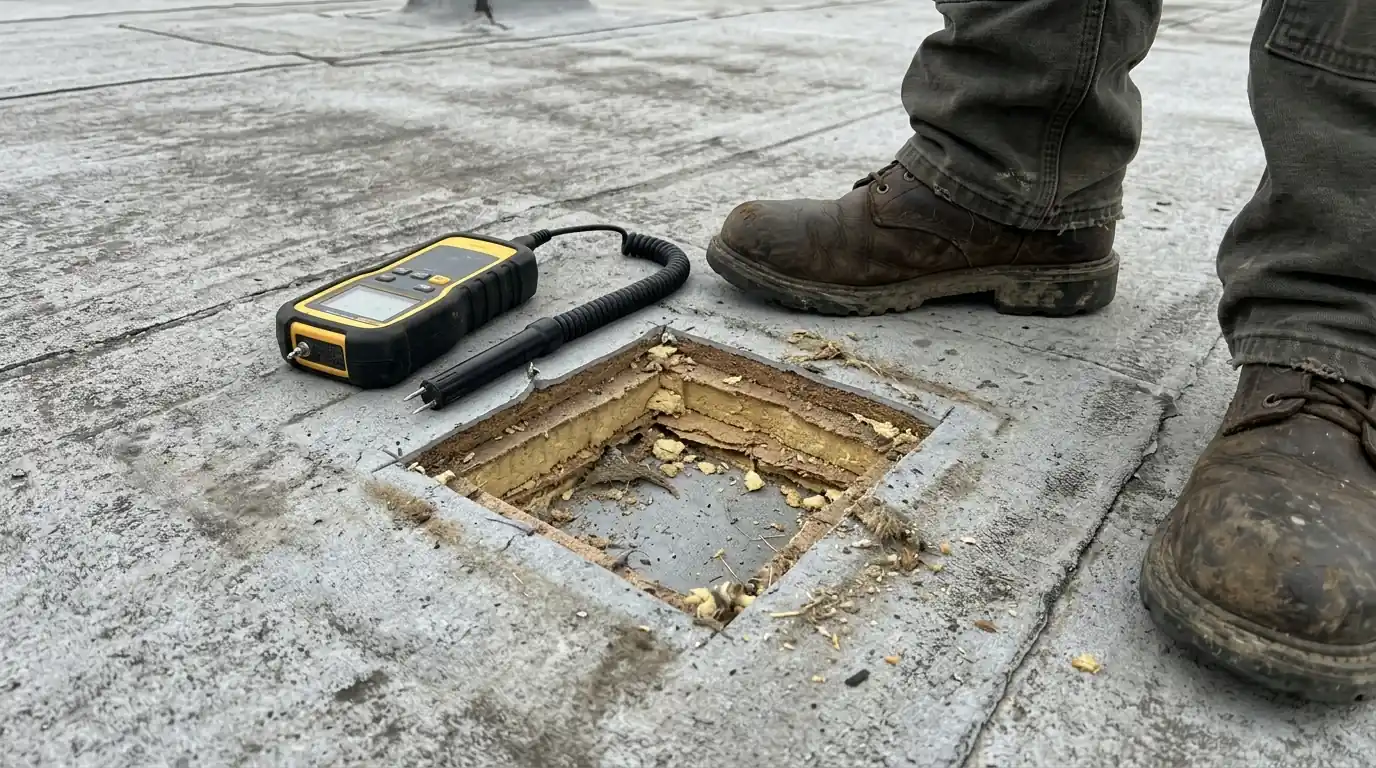
On a large flat roof, water can enter at one spot and show up inside thirty feet away. Chasing ceiling stains rarely finds the real source. A survey walks the whole roof in a grid, checks every seam, curb, drain and edge, and maps the problems on a roof plan.
We photograph each issue and tie it to a location on the plan. Where wet insulation is suspected, core cuts confirm what is under the membrane. Owners and property managers get a clear picture of whether the roof needs targeted repairs, a restoration or replacement, along with photos they can share with ownership or a board.
Water that sits on a low-slope roof for more than a couple of days after rain is called ponding. It adds weight, speeds membrane wear, collects dirt that feeds plant growth and finds every weak seam. In summer, a pond can evaporate and leave a crust that holds heat.
Ponding usually comes from clogged drains, undersized scuppers, sagging deck or insulation that has compressed over time. Fixes range from clearing and resetting drains to adding tapered insulation crickets during a reroof so water is pushed toward outlets instead of settling in the field.
Commercial roofing happens over open businesses. We plan staging, material lifts and dumpster placement with the property manager so customer parking and storefront entrances stay usable. Noisy work and anything with odor gets scheduled around business hours where possible.
For churches, we plan around services and events, and we tarp or protect interior spaces where tear-off is happening over sanctuaries or fellowship halls. Retail tenants get notice of rooftop work days. Each day's open area is dried in before the crew leaves, because an Oklahoma afternoon storm can show up with little warning.
Spring storms in central Oklahoma hit commercial roofs as hard as homes. Hail can fracture aging membranes, crack rooftop equipment housings, dent metal edge trim and split the facers on insulation boards below. Some damage is easy to see, and some only shows up under close inspection.
Straight-line winds peel back poorly fastened edge metal and can lift membrane at corners where uplift is highest. After a storm we document the roof, equipment and edges with dated photos. Building owners make their own claim decisions; we provide the record and explain what we found.
Not every leaking commercial roof needs to come off. A membrane in fair condition with a few failed seams or flashings can be repaired for years of extra service. A sound roof with surface wear and dry insulation may be a candidate for a silicone restoration.
When insulation is saturated across large areas, the deck is rusting or the membrane is failing everywhere, replacement is the honest answer. We lay out each option with its tradeoffs so owners can plan budgets and timing rather than react to the next leak.
HVAC units, exhaust fans, gas lines, conduit and skylights all pierce a commercial roof. Each penetration needs a curb, pitch pocket or boot that is properly flashed to the membrane. Failed pitch pockets and loose curb flashing are among the most common leak sources we find.
We also look at how service technicians have treated the roof. Walk pads near equipment keep foot traffic from wearing through the membrane, and loose screws or panels left on the roof after a service visit can puncture it.
Brown rings or sagging tiles in a suite or hallway mean water has been getting in for a while.
Ponds that remain two days after a storm point to drainage or deck problems.
Lifted seams, blisters and wrinkles in the membrane are common entry points.
Edge trim that rattles or has lifted after wind can let the membrane peel back.
Drips near HVAC units or exhaust fans often trace to failed curb flashing or pitch pockets.
Hail can fracture aging membranes and damage rooftop equipment without obvious signs from the parking lot.
The same people who look at your roof are the ones who do the work, and they explain each step before it happens.
Call (405) 864-0080We walk the entire roof, photograph defects and mark them on a roof plan.
Core cuts where needed tell us the layers, insulation type and whether it is wet.
We explain repair, restoration and replacement paths with photos and tradeoffs.
Staging, noise and work hours are set with the property manager, pastor or tenants.
Our crew completes the work, dries in daily and delivers a photo record of the finished roof.
Every roof is priced after we have seen it. These are the things that move the number up or down.
Call any hour. Our own crew inspects, photographs and explains the fix before any work starts.
Once a year is a sensible baseline, plus after any significant hail or wind event. Regular surveys catch failing seams and clogged drains before they turn into interior damage.
In most cases, yes. We schedule loud work and tear-off around services and events, protect interior spaces and dry the roof in every day.
Yes, when it lingers. Standing water adds weight, speeds membrane wear and finds weak seams. The fix may be as simple as clearing drains or may need tapered insulation.
Reflective white systems like TPO and silicone coatings keep surface temperatures lower, which helps cooling costs. The right choice also depends on the deck, foot traffic and what is already on the roof.
Yes. Light commercial work such as strip centers, offices, churches and shop buildings is a regular part of what our crews do across the metro.
White TPO single-ply roofs for OKC commercial buildings and low-slope homes, heat-welded seams, attached or adhered to suit the deck.
Learn moreRepairs for flat and low-slope roofs on OKC homes, porches, additions and small shops: ponding, blisters, seams, scuppers and drains.
Learn moreSilicone coatings that restore sound low-slope roofs in the OKC metro, after a moisture survey, careful cleaning and proper prep.
Learn moreRoof repair and phased replacement for apartments, duplexes and townhome HOAs across the Oklahoma City metro.
Learn moreOklahoma City and the surrounding metro, including:
Logan CountyDeer Creek, Oklahoma CityMesta Park, Oklahoma CityCapitol Hill, Oklahoma CityEdmondMustangNewcastleEl RenoAll service areas