Shingle Repair
Mid-century Warr Acres roofs often need targeted shingle repairs at lifted tabs, worn spots and old patches.
Learn moreSapphire Roofing repairs and replaces shingle roofs across Warr Acres with our own crews. Most homes here are 1940s to 1960s ranch houses on small lots, so we see worn shingles, cracked pipe boots, leaky chimney flashing, thin attic ventilation and hail damage. Call us any hour and we'll inspect, photograph what we find and explain your repair options.
Answered 24/7Our own crews work in Warr Acres.
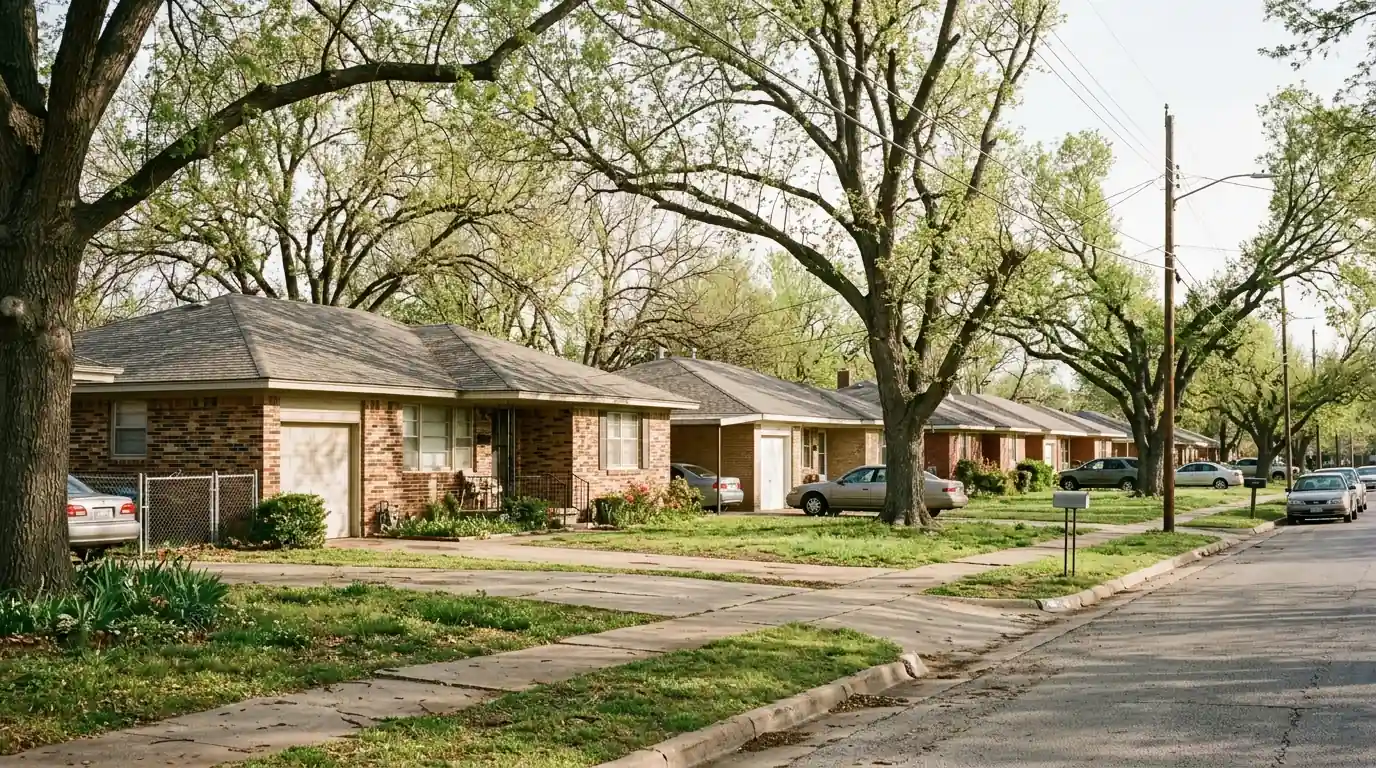
Warr Acres is a small, tightly built city on the northwest side of the metro, centered on North MacArthur Boulevard with Oklahoma City and Bethany around it. Its neighborhoods are full of compact one-story homes from the post-war building boom, set close together on tree-lined streets.
Homes of that age have usually had several roofs already, and the next one has to deal with what's underneath: older decking, past patches and ventilation that was never quite enough. Our crews inspect carefully, photograph every problem and walk you through what needs fixing now and what can wait.
Builder and developer C.B. Warr platted the original Warr Acres additions in 1937. The Putnam City addition, laid out in 1909 by state lawmaker Israel Putnam, later became part of the city too. In February 1948, residents of eleven additions petitioned to incorporate, and the new city survived a legal challenge from Bethany at the Oklahoma Supreme Court.
Growth was fast after that: from about 2,400 residents in 1950 to more than 7,000 in 1960 and nearly 9,900 by 1970, then roughly flat. That means most Warr Acres houses went up within about twenty years of each other, and the roofs on whole blocks tend to have similar construction and similar problems.
Shopping strips grew up along North MacArthur Boulevard, Northwest Expressway and NW 39th Street, the old Route 66 alignment, in the 1960s and 1970s. Many of those commercial buildings have flat or low-slope roofs, and older ones often have aging built-up or modified bitumen roofs with ponding and seam leaks.
The Putnam City school district has its high school and administration offices in Warr Acres, and the residential streets between those campuses and the commercial corridors are lined with simple hip or gable ranches, most with brick or siding walls and many with a single chimney.
A typical Warr Acres roof is a low to medium pitch over a one-story house of modest size, often with a short valley where a garage or later addition ties in. Low slopes and add-on valleys are where most leaks start, along with pipe boots that have cracked in the sun.
Once the old shingles come off, we often find plank decking, past repairs with mismatched sheathing and soft spots near the eaves. We replace damaged decking, add drip edge if there wasn't any, and install new underlayment and flashing instead of reusing what's there.
Many homes from this era were built with small gable vents and little or no soffit intake. In an Oklahoma summer, that traps heat in the attic and bakes shingles from below, which shows up as curling, cracking and early granule loss even on a roof that isn't that old.
When we reroof a Warr Acres home, we check whether adding soffit vents and a ridge vent would balance the attic. It's one of the least expensive changes you can make during a replacement and it helps the new roof last.
Decades-old elms, oaks and pecans shade a lot of Warr Acres streets. They drop limbs in ice storms, like the October 2020 storm that broke trees across the metro, and fill gutters every fall. Hail in the spring season adds to it, and close-set houses on the same block usually take the same storm.
The calls we get most here are shingle repairs, leaks around pipe boots and chimneys, full replacements on worn-out roofs, and gutter repair. Whatever the job, we photograph it so you can see exactly what we found.
Mid-century Warr Acres roofs often need targeted shingle repairs at lifted tabs, worn spots and old patches.
Learn moreCracked pipe boots and add-on valleys on low-pitch ranch roofs cause most of the leaks we trace here.
Learn moreHomes from the 1940s to 1960s were often built with little soffit intake, which bakes shingles from below.
Learn moreMature trees on Warr Acres streets fill and bend gutters, and older fascia attachments loosen.
Learn moreStrip centers along MacArthur, NW 39th and Northwest Expressway carry aging low-slope roofs.
Learn moreCall Sapphire. Our own roofers inspect, photograph and fix the problem, and we explain it first.
Often, yes. If the damage is limited and the rest of the roof has life left, we'll repair the lifted, cracked or missing shingles and any flashing involved. We'll show you photos so you can see whether a repair makes sense or the whole roof is worn out.
Many homes from that era have small gable vents and little soffit intake, so hot air has nowhere to go. Adding soffit vents and a ridge vent during a reroof usually helps a lot, and it protects the new shingles from heat damage.
Many do. Plank decking can hold a new roof if the boards are sound, but we often find soft or rotted boards near the eaves. We replace what's damaged and photograph it so you know exactly what was done.
Yes. We repair and replace low-slope roofs on shops and offices along MacArthur, NW 39th and Northwest Expressway, including modified bitumen, TPO and EPDM. We'll find where water is ponding or getting in and explain the options.