Attic Insulation
Air sealing first, then blown-in or batt attic insulation with baffles, so OKC homes stay cooler in summer and warmer in winter.
Learn moreAn attic is a box of air sitting under a dark roof in the Oklahoma sun. On a July afternoon in the metro, the air up there gets far hotter than the air outside, and that heat pushes down into the living space and up into the shingles. In January the same attic can trap warm, damp air from the house that condenses on cold roof decking.
Answered 24/7Call (405) 864-0080 and talk to Sapphire.
Roof ventilation moves outside air through the attic, in low at the soffits and out high at the ridge or roof vents. In Oklahoma City, a balanced system keeps summer attic heat from cooking shingles and stops winter moisture from condensing on the underside of the deck. The goal is matched intake and exhaust, not simply more vents.
Ventilation solves both problems when it is set up correctly. Sapphire's crews check the intake and exhaust on every roof we work on, and we take on ventilation corrections as standalone jobs too. We explain what your attic has now, what is out of balance and what the fix involves, using photos from your own attic.
Warm air rises. A vented attic uses that by pulling cooler outside air in through vents low on the roof, usually at the soffits under the eaves, and letting warm air out through vents near the peak. The air sweeps along the underside of the deck as it goes, carrying heat and moisture with it.
For that to happen, the intake and exhaust have to be roughly balanced, and the path between them has to be open. Blocked soffits, insulation stuffed against the eaves, or two kinds of exhaust fighting each other all break the flow even when the roof has plenty of vents on it.
Long stretches of triple-digit days are normal here in a hot summer. A poorly vented attic soaks up that heat and holds it into the night, which keeps your air conditioner running long after sundown and makes upstairs bedrooms hard to cool.
Shingles feel it too. Asphalt shingles sitting on an overheated deck lose their oils faster, curl at the edges and shed granules sooner than the same shingles on a well-vented roof. Many shingle manufacturers also spell out ventilation expectations in their installation instructions, so poor airflow can complicate warranty questions later.
Cold snaps here can be sharp, and the attic deck gets cold fast. Warm, humid air from showers, cooking and breathing finds its way into the attic through gaps around light fixtures, attic hatches and plumbing chases. When it hits the cold underside of the deck, the moisture condenses.
Over a few winters that shows up as frost on nail tips, dark staining on the plywood, rusty nails and damp insulation. In bad cases the decking delaminates and goes soft. Proper exhaust carries that moisture out before it settles, and air sealing below cuts how much reaches the attic in the first place.
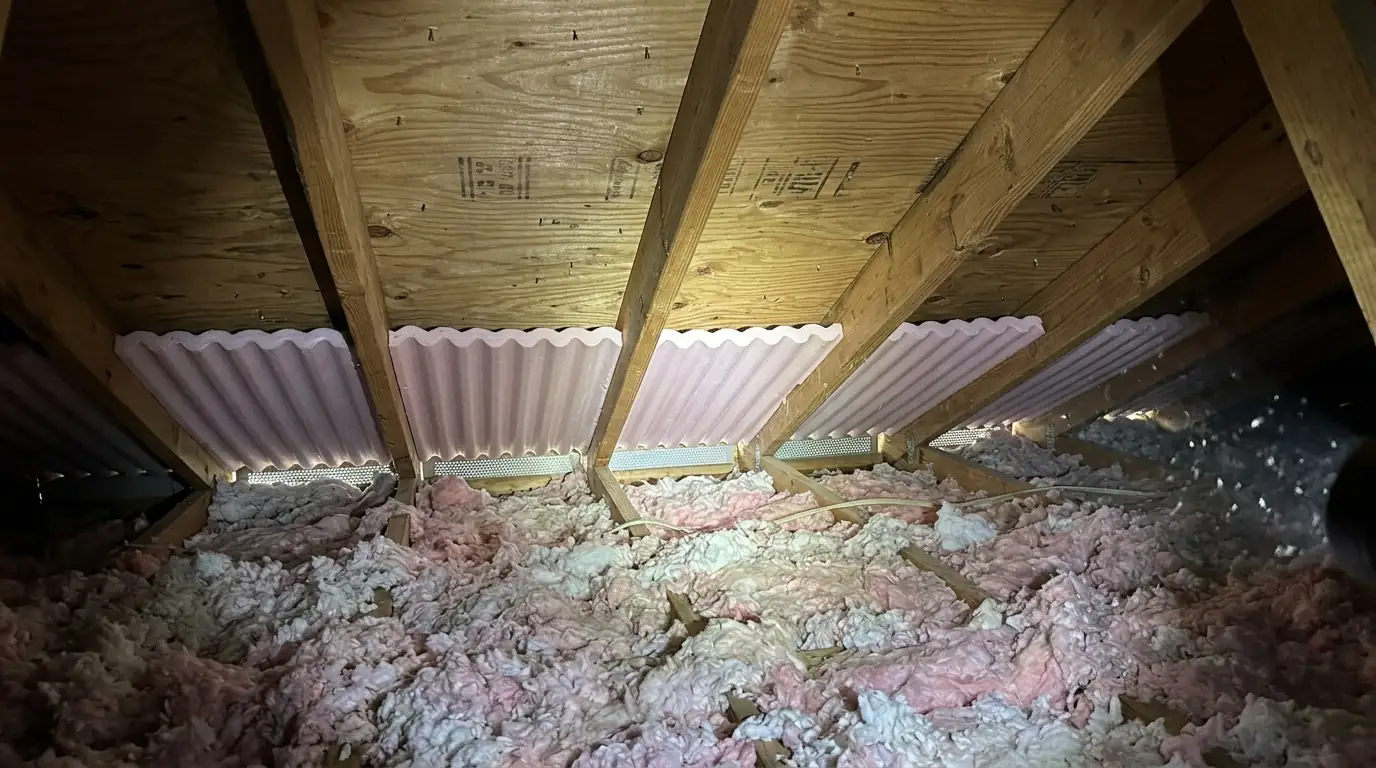
Most homes in the metro take in air through perforated vinyl or aluminum soffit panels or through individual rectangular soffit vents cut into wood soffits. Both work if the openings are not painted over or blocked from behind by insulation.
Some houses, especially older ones with narrow or no overhangs, have no real soffit to vent. For those we look at drip-edge intake vents that sit at the roof's lower edge. We also install baffles inside the attic so insulation stays back from the eaves and air has a clear channel up the rafter bay.
Exhaust is where homeowners see the most variety, and where the most mistakes get made. Each type has its place, and mixing types on the same attic often makes airflow worse rather than better.
Powered fans deserve a careful look. They can move a lot of air, but if intake is short they pull conditioned air up out of the house through ceiling gaps, and the motors eventually wear out. We install them only where the attic layout calls for one and the intake can keep up.
The most common problem we find in OKC attics is mixed exhaust: a ridge vent added during a reroof while the old box vents or gable vents were left in place. Air takes the shortest path, so the ridge vent pulls from the nearest box vent instead of from the soffits, and the lower attic stays stagnant.
Next is buried intake. Blown-in insulation added over the years drifts into the eaves and plugs the soffit openings. The roof looks properly vented from outside, but almost no air comes in. Bath fans vented into the attic instead of through the roof are another frequent find, and they dump moisture right where it does the most harm.
A roof replacement is the easiest time to fix ventilation, because the deck is open. We can cut a proper ridge slot, close off old box vents with new decking, add intake where it is missing and reroute bath fans through dedicated roof jacks.
If your roof still has years left, ventilation can be corrected on its own. Adding soffit intake, installing baffles and swapping exhaust types are all jobs we handle without tearing off the shingles. We will tell you which approach makes sense for your house.
Bedrooms under the roof stay warm well into the evening even with the air conditioner running.
Frost on nail tips in winter or rusty nails and dark staining on the deck point to trapped moisture.
Curling, blistering or heavy granule loss on a roof that is not very old can mean the deck runs hot.
A ridge vent alongside box vents, turbines or gable vents often short-circuits airflow.
Painted-over soffit vents or insulation packed against the eaves cut off intake.
Exhaust fans that dump into the attic instead of outdoors add moisture right under the deck.
The same people who look at your roof are the ones who do the work, and they explain each step before it happens.
Call (405) 864-0080We check every intake and exhaust opening, measure the attic and photograph moisture or heat damage.
We show you how much intake and exhaust you have now and what is blocking the flow.
We propose a single exhaust type matched to enough intake, rather than layering more vents.
Our crew cuts in vents, closes off conflicting ones, installs baffles and flashes everything properly.
We confirm clear airflow paths at the eaves and ridge and share photos of the finished work.
Every roof is priced after we have seen it. These are the things that move the number up or down.
Call any hour. Our own crew inspects, photographs and explains the fix before any work starts.
Usually not. Two exhaust types on one attic tend to pull air from each other instead of from the soffits. We generally pick one exhaust type and close off the others.
They can help in specific attics, but only with enough intake to feed them. Without it, they pull cooled air out of the house through ceiling gaps. We check intake before recommending one.
Yes. Shingles over a hot, stagnant attic tend to curl and shed granules sooner. Good ventilation keeps the deck closer to outside temperature and slows that wear.
Warm, moist air from the house is leaking into a cold attic and condensing on the deck. The fix is usually a mix of air sealing below and better exhaust above.
Often, yes. Adding soffit intake, installing baffles and swapping exhaust vents can all be done on an existing roof. A reroof just makes the bigger changes easier.
Air sealing first, then blown-in or batt attic insulation with baffles, so OKC homes stay cooler in summer and warmer in winter.
Learn moreFull tear-off roof replacement in Oklahoma City, from decking checks and underlayment to a magnet sweep of your yard.
Learn moreSoffit and fascia repair for rot, squirrel and bird entry, and blocked attic intake vents, finished in aluminum wrap.
Learn moreRoof inspections in Oklahoma City covering shingles, flashing, attic and decking, with photos and a plain-language report.
Learn moreOklahoma City and the surrounding metro, including:
The VillageCanadian CountyLansbrook, Oklahoma CityCrown Heights, Oklahoma CityGatewood, Oklahoma CityWestmoore, Oklahoma CityYukonChoctawAll service areas