TPO Roofing
White TPO single-ply roofs for OKC commercial buildings and low-slope homes, heat-welded seams, attached or adhered to suit the deck.
Learn moreEPDM has been on low-slope roofs for decades, and plenty of buildings around the metro still have their original black rubber roof. It is flexible, handles freeze-thaw swings well and comes in wide sheets that mean fewer seams across a roof.
Answered 24/7Call (405) 864-0080 and talk to Sapphire.
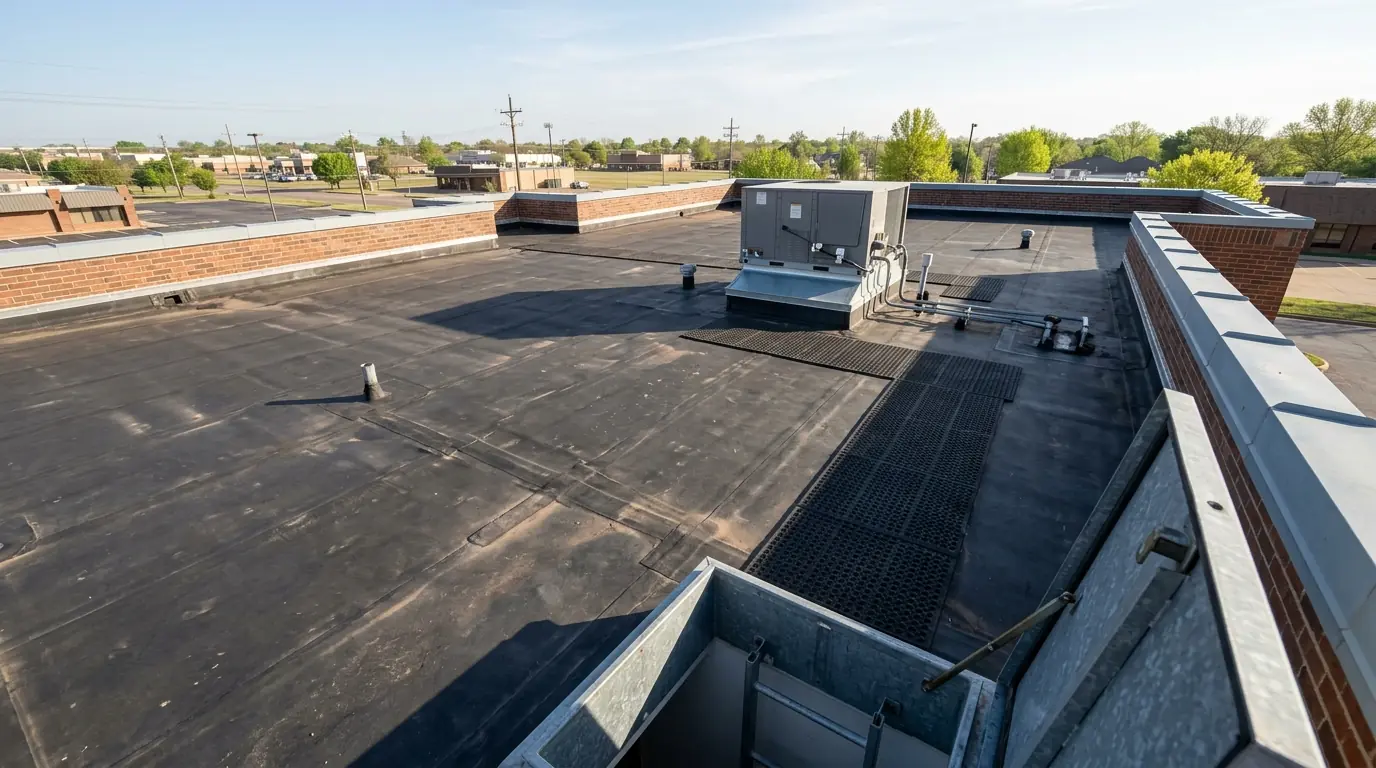
EPDM is a black synthetic rubber membrane used on flat and low-slope roofs. Its sheets are joined with seam tape and primer, and it can be fully adhered, mechanically fastened or held down with ballast stone. In Oklahoma City it is common on older offices, schools, churches and additions. Sapphire installs new EPDM and repairs shrinkage, seam and flashing problems on existing roofs.
Sapphire works on EPDM roofs on commercial buildings, church education wings, older office parks and residential low-slope sections. Our own crews install new rubber roofs and repair existing ones, and we start by figuring out how the current roof was built so every repair uses compatible materials.
EPDM stands for ethylene propylene diene monomer, a synthetic rubber. On the roof it looks and feels like a thick black inner tube. It stays flexible in cold weather and stretches without tearing, which is useful through central Oklahoma winters when a mild afternoon can give way to a hard freeze overnight.
Because it is black, EPDM absorbs heat in summer. On a building with good insulation beneath, that matters less than it sounds. Where cooling load is a concern, a white EPDM or a reflective coating can be considered.
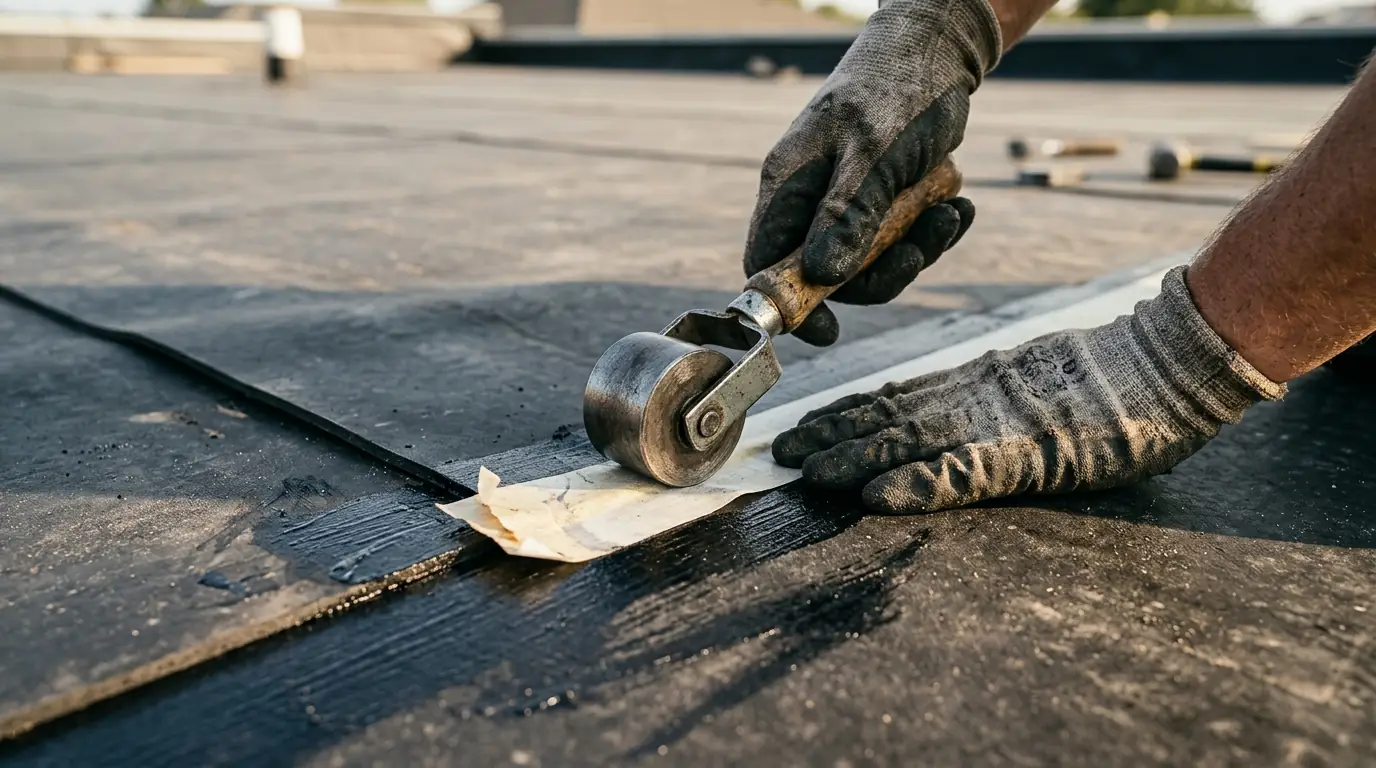
Unlike TPO, EPDM cannot be heat welded. Sheets are joined by priming both surfaces, then pressing a factory seam tape between them and rolling it down. Older roofs used liquid splice adhesive instead, and many of the open seams we see on aging EPDM are those adhesive seams letting go.
A taped seam is only as good as its prep. The membrane must be clean, dry and fully primed, and the tape must be rolled to full contact without wrinkles. We take our time here because a rushed seam is the most common reason a rubber roof leaks within a few years.
EPDM can be installed three ways, and knowing which one is on your roof shapes how it gets repaired. Fully adhered roofs are glued down across the whole surface. Mechanically fastened roofs are held with plates and screws along the seams. Ballasted roofs are laid loose and held down by a layer of river stone.
Ballasted roofs are fast to install and the stone protects the rubber from sun and hail, but the stone adds weight and makes finding leaks harder because it must be moved aside. Adhered roofs are easier to inspect and repair and tend to be the choice on smaller buildings and residential sections.
Older EPDM sheets tend to shrink slightly over years of sun and heat. As the field sheet shrinks, it pulls on the flashings at walls, curbs and edges. You can sometimes see the result: membrane stretched tight across an inside corner like a drum, or flashing pulled away from the base of a parapet.
That tension eventually tears the membrane or opens the flashing seam, and water runs straight down the wall. Repairs involve relieving the tension, adding new membrane strips and securing the base of the wall flashing with termination bar so it cannot pull again.
Pipes get pre-molded rubber boots, or field-wrapped uncured flashing on odd sizes. Curbs and walls get membrane turned up and secured under counter-flashing or a termination bar. Drains are clamped with a ring to the drain bowl after the membrane is cut in.
Uncured EPDM flashing can be molded around irregular shapes, then cures in place. We use it on pitch pockets and odd corners where a pre-formed piece will not fit. Many leaks we chase on older roofs trace to field-wrapped pipe flashings that have cracked from age.
Rubber does not bond to asphalt products, and roofing cement smeared on EPDM can soften and damage the membrane. Yet tar patches on rubber roofs are one of the most common things we find. Those patches have to be cleaned off before a proper repair can go on.
A correct EPDM repair cleans the old surface with a dedicated cleaner, primes it, and applies a cured patch or seam tape with rounded corners so edges do not lift. Older, weathered rubber takes more cleaning, but it can still accept a good repair if the sheet itself is sound.
Rubber's flexibility helps it shrug off small hail, but large stones can bruise it, and hail can crush the insulation board under it even when the membrane looks fine. Ballast stone adds some protection, at the cost of weight and harder inspections.
Wind is a concern at edges and corners, where uplift is strongest. Loose edge metal lets wind get under the sheet. After severe wind events we check the perimeter, corners and any spots where the rubber is billowing or no longer laying flat.
Old adhesive seams that curl open at their edges are a leading cause of rubber roof leaks.
Rubber stretched tight across corners or away from parapets is a sign of shrinkage.
Asphalt patches on EPDM often fail and can damage the sheet around them.
Field-wrapped flashings around pipes crack with age and let water down the pipe.
Bare spots in a ballasted roof expose the rubber to sun and wind.
A sheet that lifts or flutters in wind may have lost adhesion or edge securement.
The same people who look at your roof are the ones who do the work, and they explain each step before it happens.
Call (405) 864-0080We confirm whether the roof is adhered, fastened or ballasted and how its seams were made.
Our crew checks every seam, flashing and edge, photographing shrinkage and open laps.
Old surfaces are cleaned of dirt and any asphalt patches, then primed for new material.
We apply seam tape, cured patches or new membrane, rolled down for full contact.
Wall flashings, termination bar and edge metal are fastened so the repair holds through wind.
Every roof is priced after we have seen it. These are the things that move the number up or down.
Call any hour. Our own crew inspects, photographs and explains the fix before any work starts.
Older rubber sheets shrink slightly over time and pull on the wall flashing. Eventually the flashing tears or separates. The fix is new membrane at the base of the wall secured with termination bar.
No. Asphalt products do not bond to rubber and can damage it. EPDM needs a dedicated cleaner, primer and seam tape or cured patches.
It takes more time, because the stone has to be moved to find and fix leaks. The rubber underneath is repaired the same way once it is exposed.
It absorbs more heat than a white roof, but it tolerates high temperatures well. Good insulation below limits how much heat reaches the building.
If the sheet is still flexible and the insulation is dry, repairs can carry it for years. Widespread shrinkage, many failed seams or wet insulation usually point to replacement.
White TPO single-ply roofs for OKC commercial buildings and low-slope homes, heat-welded seams, attached or adhered to suit the deck.
Learn moreRepairs for flat and low-slope roofs on OKC homes, porches, additions and small shops: ponding, blisters, seams, scuppers and drains.
Learn moreLow-slope roof repair, replacement and surveys for OKC retail centers, offices, churches and warehouses, worked around your tenants.
Learn moreSilicone coatings that restore sound low-slope roofs in the OKC metro, after a moisture survey, careful cleaning and proper prep.
Learn moreOklahoma City and the surrounding metro, including:
Crown Heights, Oklahoma CityGatewood, Oklahoma CityWestmoore, Oklahoma CityYukonChoctawThe VillageCanadian CountyLansbrook, Oklahoma CityAll service areas