Gutter Guards
Gutter guards chosen for the debris your trees actually drop, from oak and elm leaves to pine needles and cottonwood fluff.
Learn moreSectional gutters from the big-box store are joined every 10 feet, and every joint is a sealant bead waiting to fail. A seamless gutter run is pulled off a coil and shaped by a roll-forming machine in our trailer, then cut to the exact length of your eave. The only joints left are mitered corners and the end caps.
Answered 24/7Call (405) 864-0080 and talk to Sapphire.
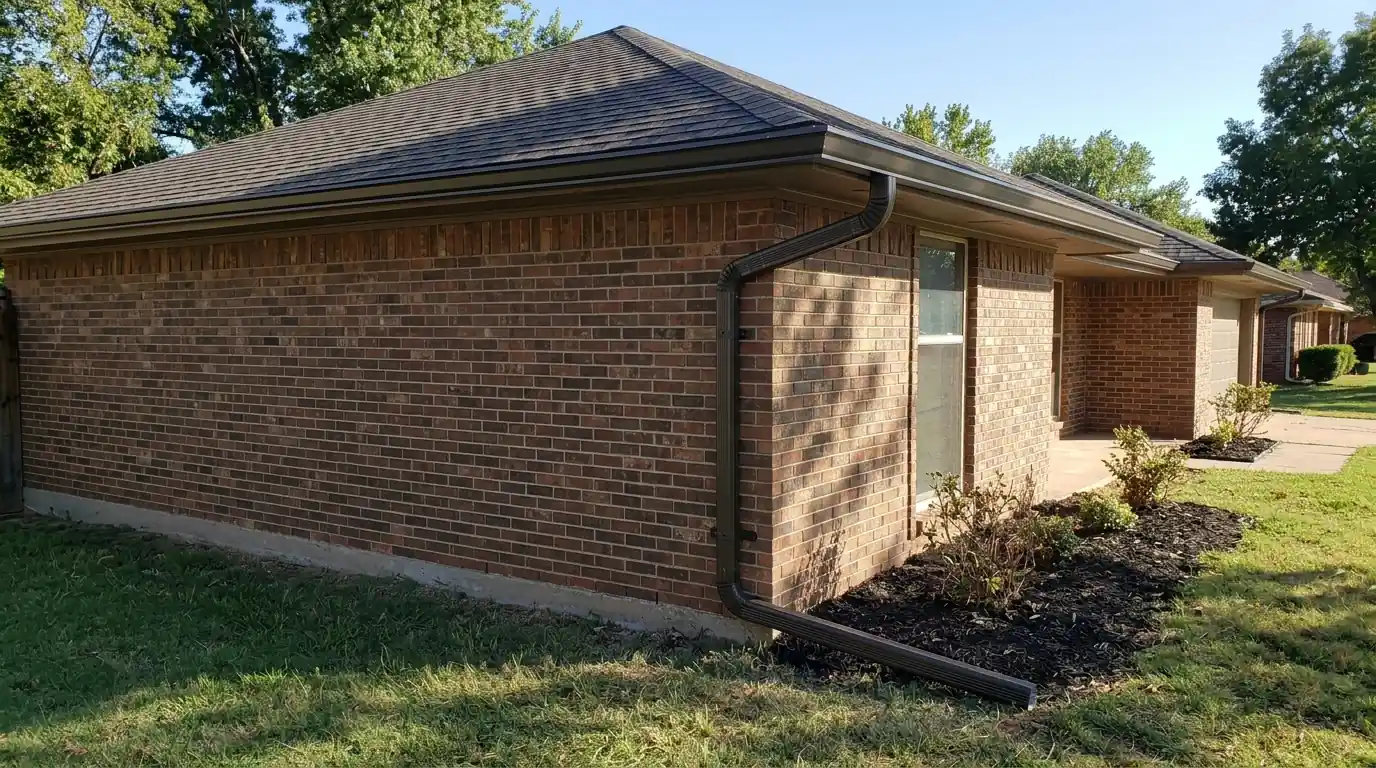
Seamless gutters are formed on site from a single coil of metal, so each run has no joints except at corners and end caps. In Oklahoma City, most homes do best with 6-inch K-style aluminum and 3x4 downspouts, because spring thunderstorms can drop more water in an hour than a 5-inch gutter with 2x3 outlets can carry away.
Sapphire installs seamless gutters across the Oklahoma City metro, often right after a roof replacement but just as often on their own when hail has dented the old runs or the downspouts can't keep up. We measure, roll, hang and test on the same visit, and our own crew does the work from start to finish.
K-style gutters have a flat back and a decorative front that looks a bit like crown molding. They hold more water than a half-round gutter of the same width, they mount flat against the fascia board, and they suit the brick ranch homes and newer two-story builds that make up most of the metro.
Half-round gutters are a true half circle hung from exposed brackets. They drain cleaner because nothing sits in a flat bottom, and they look right on Craftsman bungalows and Tudor-style homes in neighborhoods like Crown Heights, Mesta Park and Heritage Hills. They usually cost more to fabricate and hang, and a half-round of the same width carries less water.
The 5-inch K-style is the builder standard, and it works on small, low-pitch roof planes. The trouble starts on steep roofs and long valleys. A steep slope sends water faster, and a valley concentrates two roof planes into one point, so the gutter below a valley often overflows even when the rest of the run is fine.
A 6-inch gutter holds roughly 40 percent more water than a 5-inch one and accepts a larger downspout. On most two-story homes and any roof with a big valley dumping onto a short run, we recommend 6-inch. It's the single change that stops most of the overflow we see during May storms.
A gutter only drains as fast as its outlets. Standard 2x3 downspouts are easy to clog with shingle granules, maple seeds and elm leaves. A 3x4 downspout moves far more water and passes debris more easily, so we pair it with every 6-inch run and add extra drops on long eaves.
Where the water lands matters as much as how fast it leaves. Oklahoma red clay swells when wet and shrinks in summer drought, and that movement cracks slabs and stem walls. We extend downspouts away from the foundation, aim them toward a slope or splash block, and avoid dumping water onto driveways where it can freeze in winter.

Coated aluminum is the most common choice here. It doesn't rust, it comes in dozens of colors to match trim, and it's light enough to hang on older fascia without much reinforcement. Its weakness is hail: thinner aluminum dents easily, so we use a heavier gauge coil on most homes.
Galvanized or coated steel shrugs off hail much better and stands up to ladders leaning on it, but it's heavier and will rust where the coating is scratched or cut. Copper is the long-lived option for historic homes and half-round profiles. It weathers to a brown and then green patina, and it needs copper fasteners and brackets so the metals don't corrode each other.
After a hailstorm, dented gutters and downspouts are often the easiest damage to see from the ground, and adjusters use them as evidence of hail size and direction. Dents in the top lip or the face of a K-style gutter can also kink the run and slow drainage.
We photograph gutter and downspout damage on every side of the house as part of a storm inspection, along with the roof itself. If the roof is being replaced on the same claim, it usually makes sense to replace gutters at the same time, so the new drip edge and gutter line up and nothing gets bent coming off during tear-off.
We use hidden hangers screwed into the fascia and through to the rafter tails where we can, spaced closer than the typical builder spacing so the run holds the weight of water, wet leaves and the occasional ice load. Spikes and ferrules pull out over time; screws don't.
Each run is pitched toward its outlets so water doesn't sit, and the gutter tucks behind the drip edge so roof runoff can't slip down the back of the gutter and rot the fascia. Before we leave, we run a hose on every run and watch each downspout drain.
If water pours over the gutter lip in a normal rain, the run is too small, clogged or pitched the wrong way.
Sectional gutters leaking at every 10-foot seam mean the sealant has failed and will keep failing.
Dents across the face and crushed downspouts after a storm can slow drainage and are worth documenting for a claim.
Trenches dug into mulch or bare red clay under the eaves show where water is overshooting or leaking.
Short downspouts that dump next to the slab feed the swelling clay that cracks foundations.
Runs leaning out from the fascia mean spikes have loosened or the board behind them is soft.
The same people who look at your roof are the ones who do the work, and they explain each step before it happens.
Call (405) 864-0080We measure every eave, check roof pitch and valleys, and probe the fascia for rot before recommending a size.
You choose K-style or half-round, 5 or 6 inch, the metal and the color, with our recommendation for your roof.
We take down the old runs, inspect the fascia behind them and replace any soft board before hanging new metal.
Our crew rolls each run to length in the trailer, miters the corners and hangs it with screwed hidden hangers.
We run water through every section, adjust any slow outlet and haul away the old gutters and scraps.
Every roof is priced after we have seen it. These are the things that move the number up or down.
Call any hour. Our own crew inspects, photographs and explains the fix before any work starts.
On most two-story homes, steep roofs and any roof with large valleys, yes. A 6-inch gutter holds much more water and takes a 3x4 downspout, which handles the heavy bursts common in OKC spring storms. Small single-story roofs with gentle pitch can still do fine with 5-inch.
Usually it's the best time. Dented gutters often appear on the same hail claim, and replacing them with the roof lets the new drip edge and gutter fit together correctly. It also avoids bending old gutters during tear-off and then patching them.
They do, and they often look more appropriate on Craftsman, Tudor and Colonial Revival homes. Half-round gutters carry a bit less water than K-style at the same width, so we may size up or add downspouts on larger roof planes.
Copper darkens to brown within a year or so and slowly develops a green patina over many years, depending on rain and exposure. It doesn't rust, and many owners of older homes like the way it ages.
Far enough to clear the backfill around the house, which usually means several feet out onto ground that slopes away. Our red clay swells when it soaks up water and shrinks in drought, so keeping roof water away from the slab is one of the simplest ways to protect a foundation.
Gutter guards chosen for the debris your trees actually drop, from oak and elm leaves to pine needles and cottonwood fluff.
Learn moreGutter repair for sagging runs, leaking seams and end caps, bad pitch and the rotted fascia hiding behind them.
Learn moreSoffit and fascia repair for rot, squirrel and bird entry, and blocked attic intake vents, finished in aluminum wrap.
Learn moreHail inspections that look for bruised shingles, granule loss and fractured mats, plus repair or replacement after an OKC hailstorm.
Learn moreOklahoma City and the surrounding metro, including:
NormanDel CityPiedmontShawneeMcClain CountyLake Hefner, Oklahoma CityHeritage Hills, Oklahoma CitySouthern Hills, Oklahoma CityAll service areas