Roof Replacement
Full tear-off roof replacement in Oklahoma City, from decking checks and underlayment to a magnet sweep of your yard.
Learn moreYou never see the decking once a roof is finished, but every shingle depends on it. Nails only hold as well as the wood they're driven into, and a soft spot under the shingles becomes a sag, a leak or a blow-off over time.
Answered 24/7Call (405) 864-0080 and talk to Sapphire.
Roof decking is the plywood, OSB or wood planks nailed to the rafters that everything else sits on. When it's soft, rotted or delaminated, shingles won't hold their nails and the roof can sag or leak. Sapphire finds bad decking during inspection or tear-off, shows you the damage, and replaces it with new sheathing nailed to the framing on proper spacing.
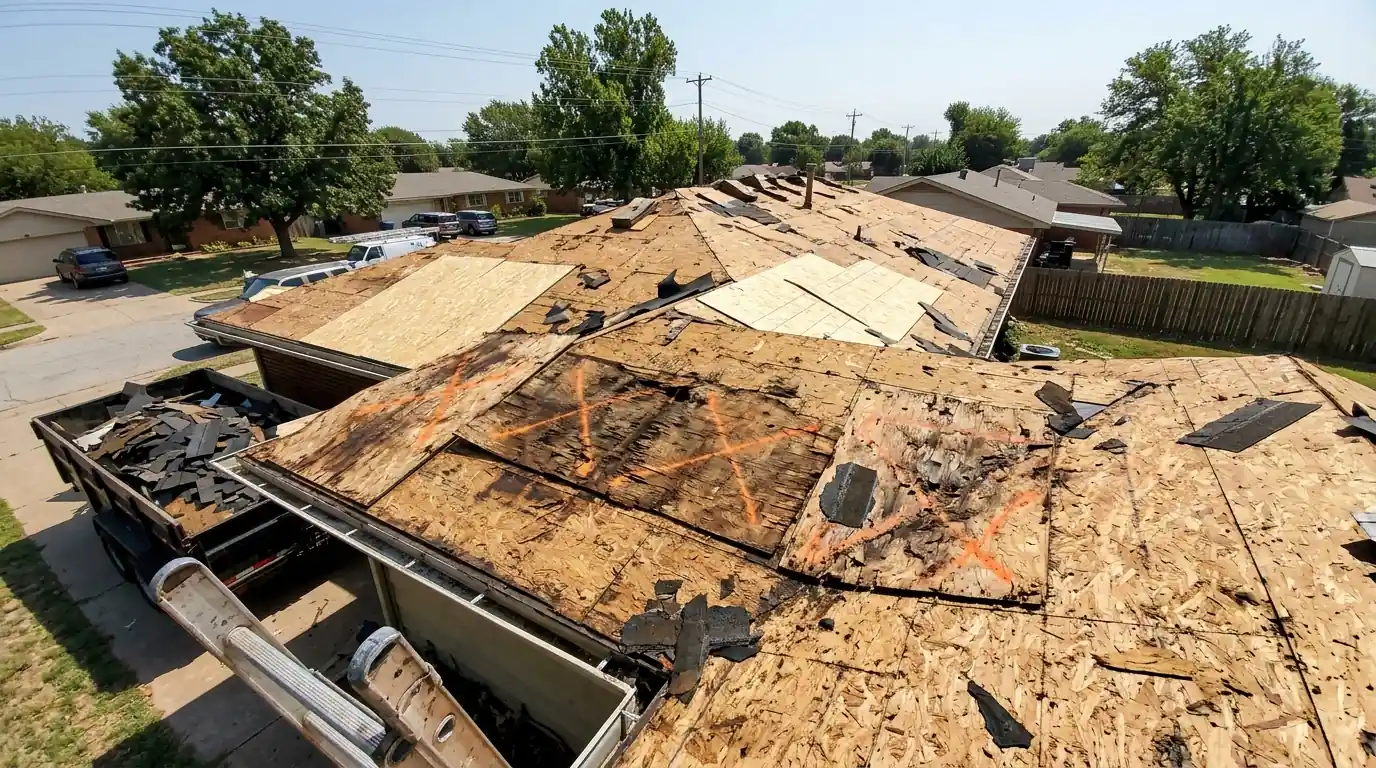
Most decking problems show up once the old shingles come off. Sapphire's crews check every sheet during tear-off, mark what's bad, photograph it and replace it before anything new goes on. Some homes need decking work as a repair on its own, after a long leak or a tree strike.
Older homes in central Oklahoma City, built before the 1960s or so, often have plank decking: one-by boards nailed across the rafters with small gaps between them. Newer homes usually have four-by-eight sheets of plywood or oriented strand board, called OSB, which is the most common sheathing today.
Each has its own issues. Planks can have gaps too wide for modern shingle nailing, and some were originally installed spaced for wood shakes. OSB is strong when dry but swells and loses strength at the edges when it gets wet repeatedly. Plywood delaminates as its layers separate after long exposure to moisture.
When the old shingles and underlayment come off, the decking tells its own history. Dark stains and soft spots show where leaks sat for months. OSB with swollen, crumbly edges along the seams has been taking on water. Fuzzy, flaking surfaces on plywood mean the outer veneer is giving up.
We walk the deck and press on suspect areas. Wood that gives underfoot, crumbles when probed or won't hold a nail gets marked for replacement. Every marked sheet is photographed so you can see exactly what we're replacing and why.
Slow leaks are the most common cause: a cracked boot or failed flashing that dripped onto the same spot for years. Attic moisture is next. When an attic doesn't vent well, warm, humid air from the house condenses on the underside of cold decking on winter nights, and repeated wetting breaks down OSB from below.
Summer works on it too. Poor ventilation lets attic temperatures soar, which bakes the decking and shingles together and shortens the life of both. When we see widespread underside damage, we look hard at intake and exhaust ventilation so the new decking doesn't suffer the same fate.
Damaged sheets are cut out back to the center of the nearest rafters so new sheets have solid framing to land on. New sheathing is cut to fit, installed with the long side running across the rafters, and staggered so seams don't line up from row to row.
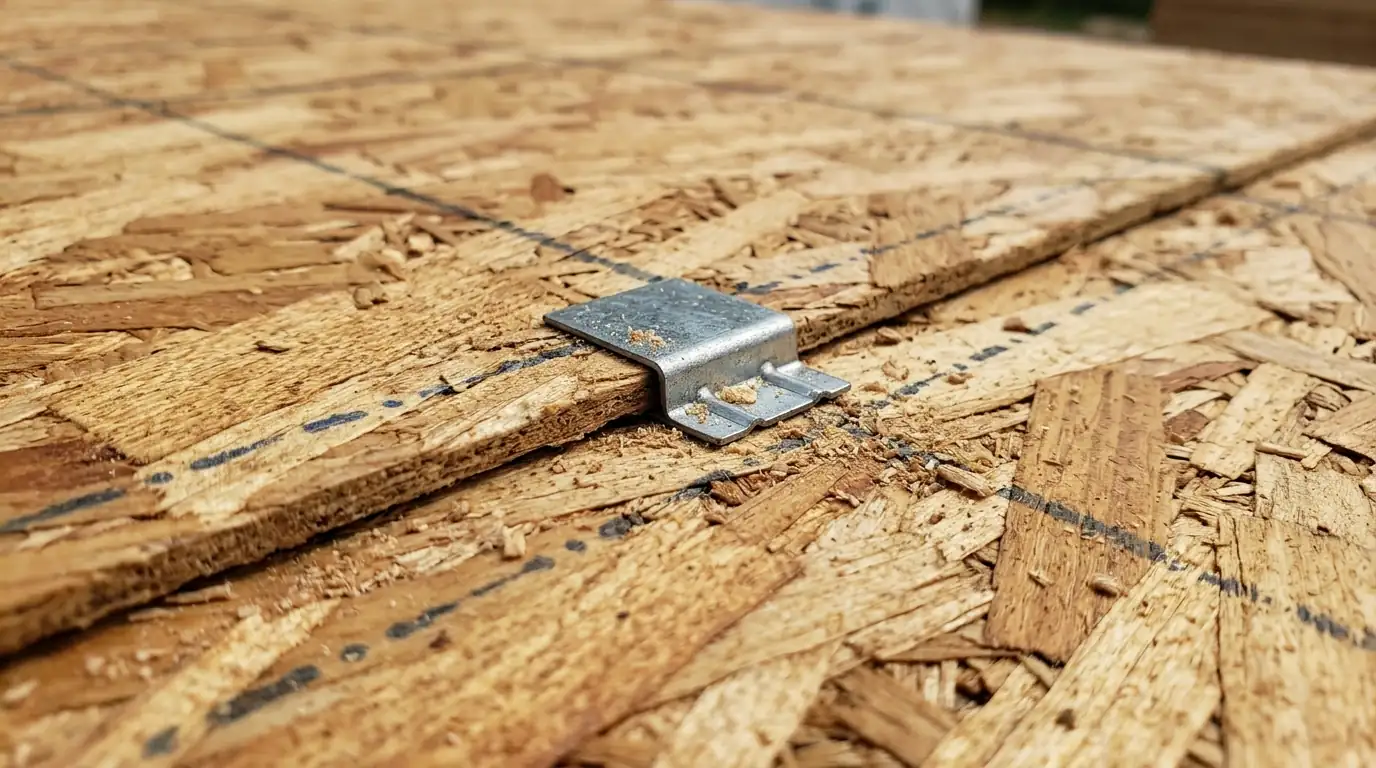
We leave a small expansion gap between sheets so they don't buckle in summer heat, and nail them to every rafter at the spacing the sheathing and code call for. Where rafters are spaced wide or the sheathing calls for edge support, we install H-clips between sheets along the unsupported edges.
H-clips are small metal clips that slip onto the edges of two adjoining sheets between rafters. They keep the edges aligned, prevent one sheet from dipping below the next, and help maintain the expansion gap. Without them, you can see ridges along the seams through the new shingles.
Nailing matters as much as the wood. Nails that miss the rafter hold nothing, and the shingles above will eventually show a wavy line. We snap lines over the framing so every nail lands in solid wood, and we check that existing good sheets are still fastened tightly before new shingles go down.
On some older homes, the plank decking is sound wood but has gaps too wide for modern shingles, or it was laid spaced for wood shakes decades ago. In those cases, the right approach is often to install new plywood or OSB sheathing over the planks, creating a continuous solid surface.
That adds strength and gives the shingle nails something consistent to grip. We'll explain whether your roof needs individual board replacement, a full overlay or a full tear-out, and show you the photos that led to the recommendation. Historic homes may also have other considerations that we'll talk through.
A dip between rafters, visible from the street, often means soft decking underneath.
A roof that feels soft or bouncy underfoot has decking that has lost strength.
Dark rings or streaks on the underside of the decking mark past or current leaks.
Moisture on the decking underside on cold nights means condensation is wearing it out.
Ridges or ripples in the shingles can trace back to swollen or uneven sheathing seams.
Any leak that went unnoticed for months has probably damaged the wood under it.
The same people who look at your roof are the ones who do the work, and they explain each step before it happens.
Call (405) 864-0080We check the decking from the attic and again at tear-off, pressing and probing suspect areas.
Every bad sheet or board is marked and photographed for your records.
Damaged wood is removed back to the nearest rafters so new sheets land on solid framing.
New sheets go in staggered, gapped, clipped and nailed to every rafter.
We confirm existing sheets are tight before underlayment and shingles go on.
Every roof is priced after we have seen it. These are the things that move the number up or down.
Call any hour. Our own crew inspects, photographs and explains the fix before any work starts.
We can estimate from the attic by looking for stains, sagging and delamination, but the exact count only shows up once the shingles are off. We photograph every replaced sheet so you see what was found.
Both meet code and perform well when kept dry and properly ventilated. Plywood tends to recover a bit better from occasional wetting, while OSB is consistent and widely used. Ventilation matters more than the choice between them.
Often, yes, if the gaps between planks are too wide for modern shingle nailing or the boards were spaced for wood shakes. A new plywood or OSB layer over the planks gives the shingles a solid base.
H-clips are small metal clips placed between sheathing panels along edges that don't land on a rafter. They keep the panels aligned and spaced, which prevents ridges and sagging between rafters.
Yes. If the soft area is limited, we remove the shingles over it, replace the damaged sheathing and rebuild the roof surface in that spot. It's a common follow-up to a leak repair.
Full tear-off roof replacement in Oklahoma City, from decking checks and underlayment to a magnet sweep of your yard.
Learn moreBalanced intake and exhaust for OKC attics: ridge vents, soffit vents and fans set up to cut summer heat and winter moisture.
Learn moreWe trace a leak back to its true entry point, often feet away from the ceiling stain, and seal the real opening for good.
Learn moreStructural roof repair after a limb or trunk lands on your house, from punctured decking to cracked rafters and crushed ridges.
Learn moreOklahoma City and the surrounding metro, including:
ChoctawThe VillageCanadian CountyLansbrook, Oklahoma CityCrown Heights, Oklahoma CityGatewood, Oklahoma CityWestmoore, Oklahoma CityYukonAll service areas