Roof Leak Repair
Varied one-off roof designs mean leaks show up at dormers, porch tie-ins and wall transitions that take careful tracing.
Learn moreSapphire Roofing repairs and replaces roofs in Putnam Heights, the historic district between NW 35th and NW 38th around McKinley and Georgia. The homes are early 20th century, mostly two-story, with Colonial Revival, Tudor, Prairie and Craftsman roof lines. We handle leak tracing, flashing, chimneys, decking and full tear-offs, and we answer 24/7.
Answered 24/7Our own crews work in Putnam Heights.
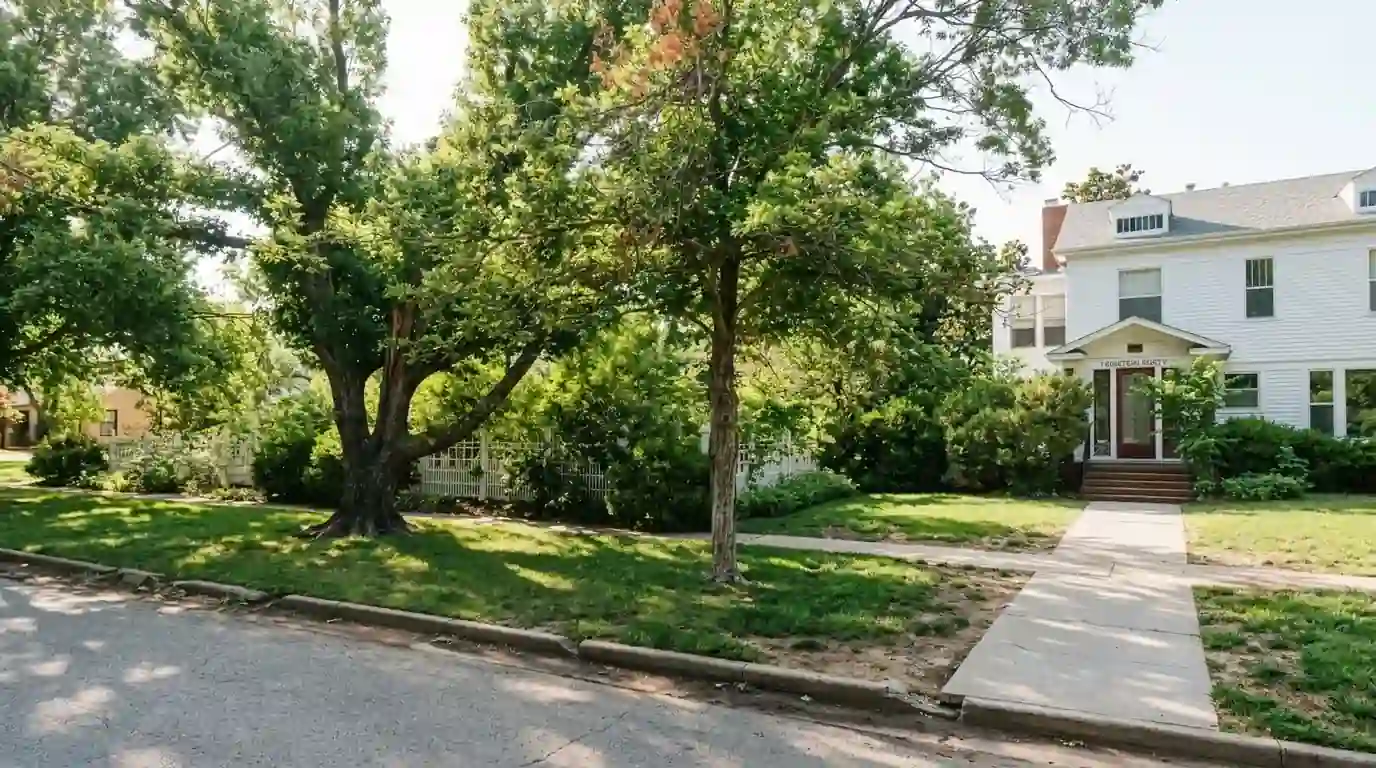
Putnam Heights is a small, tree-heavy historic neighborhood in central Oklahoma City, developed in the early 1900s and tied to developer Israel M. Putnam. The houses were designed one at a time over several decades, so no two roofs on a block are quite alike.
Most homes are two stories, with hipped Prairie roofs, steep Tudor gables, broad Craftsman eaves and Colonial Revival dormers sitting side by side. That variety is a big part of the charm, and it is also why roof work here takes more planning than on a tract-built street. Our crews come up from our south Oklahoma City office and treat each house as its own project.
Putnam Heights was designated a local historic preservation district in 1972 and later listed on the National Register of Historic Places. The district's listing notes Colonial Revival, period revival and Craftsman styles across roughly a hundred homes on the streets between NW 35th and NW 38th.
Because builders worked lot by lot, framing, decking and roof pitch vary widely. One house may have tight board decking under its shingles, while the next has had plywood added during a past reroof. We open up and check before we promise a scope, and we explain what we find with photos.
Two-story homes put the roof high above the yard, which hides problems. Wind lifts shingles along the rakes and ridges, and nobody notices until a ceiling stain shows up. Wide Craftsman and Prairie overhangs also hide rotted fascia and soffit boards behind gutters.
The details that leak most here are the ones that came with the style: dormer cheeks, wall-to-roof transitions where a one-story porch meets the main house, and masonry chimneys with old step flashing. We replace flashing as a system rather than smearing sealant over it, because sealant fails within a few Oklahoma summers.
Big elms, oaks and pecans line Putnam Heights, and the October 2020 ice storm brought down limbs across this part of the city. Tree strikes can crack rafters and decking even when the shingles above look mostly intact, so we check the attic side whenever a limb has hit.
Spring hail is the other recurring threat. Central Oklahoma City gets the same storm tracks as the rest of the metro, and older, sun-baked shingles bruise easily. After a hail day we inspect every slope, gutters and metal vents, and give you dated photos to compare against your policy's wind and hail deductible.
In a city historic district, exterior changes visible from the street may need review by the city before work starts. Changing roofing material, altering a dormer, adding a skylight to a front slope or removing a chimney are the kinds of changes that tend to need approval.
We keep roof lines, eave depth and trim profiles the way they are, and we can match shingle color to what suits the house. If you are thinking about metal or another material, we lay out the options and suggest you check with the preservation office before anything is ordered.
Our main office on S Santa Fe Ave in south Oklahoma City is about a 20-minute drive to Putnam Heights in normal traffic, using I-35 and I-235 north to NW 36th. Our Guthrie office covers the north side of the metro as well.
For an active leak or a limb through the roof, call us at any hour. We tarp and dry-in the same day when weather allows, then come back to inspect and write up the permanent repair.
Varied one-off roof designs mean leaks show up at dormers, porch tie-ins and wall transitions that take careful tracing.
Learn moreOriginal chimney and wall flashing on these early 1900s homes is often worn out or buried under old tar.
Learn moreDeep Craftsman and Prairie eaves hide rotted fascia and soffit boards behind the gutters.
Learn moreMature street trees drop heavy limbs on these roofs during ice and wind storms.
Learn moreTwo-story roofs are hard to see from the ground, so a hands-on inspection catches problems before they reach the plaster.
Learn moreCall Sapphire. Our own roofers inspect, photograph and fix the problem, and we explain it first.
Each house was designed and built individually, so pitches, decking and framing vary from lot to lot. Many have two stories, dormers and masonry chimneys, which add flashing details. We inspect and photograph before quoting so the scope matches the actual house.
Visible exterior changes in a city historic district can require review before work starts. Like-for-like replacement is usually the simplest path, while new materials or altered roof lines may need approval. Check with the city's preservation office, and we will give you photos and a written scope to bring along.
We check the attic first for loose or cracked decking, use care when tearing off older layers, and keep debris tarps and catch systems in place. If we find rotted boards, we replace them before new underlayment goes down so the new roof sits on a solid deck.
Yes. We answer 24/7 and send crews from our south Oklahoma City office, about 20 minutes away. Open roofs get tarped first, and full inspections with photos follow in daylight.