Roof Flashing Repair
Repair and replacement of step, counter, chimney, wall, valley and pipe boot flashing, the joints where most roof leaks begin.
Learn moreMost chimney leaks aren't really chimney problems or roof problems. They happen at the place where a brick column sticks through a shingle roof and the two have to share water. Cracked crowns, porous brick, failed mortar and bad flashing all let water into the attic, the ceiling around the fireplace and the wall behind it.
Answered 24/7Call (405) 864-0080 and talk to Sapphire.
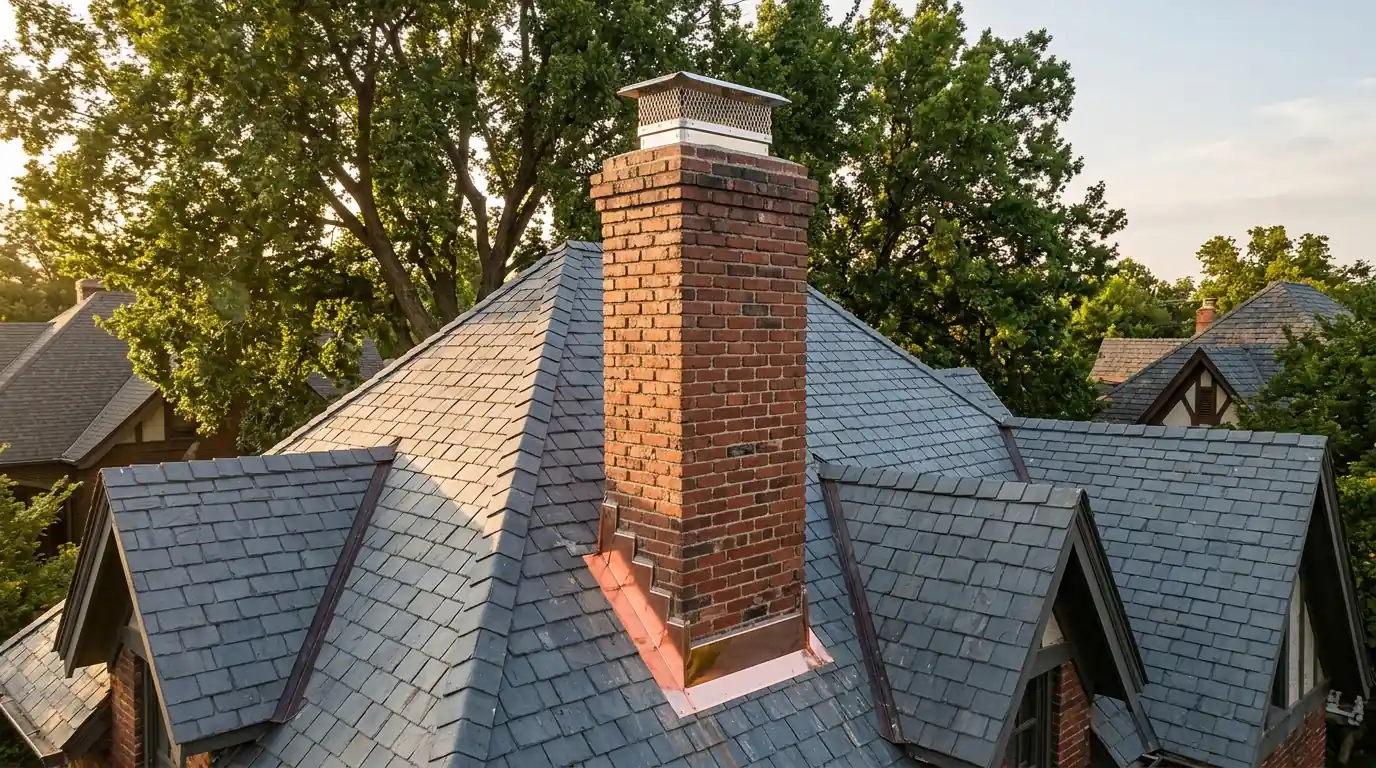
Chimney repair covers the masonry and the roof connection of your chimney: rebuilding cracked crowns, replacing spalling brick, repointing mortar, installing caps, building crickets behind wide chimneys, and replacing the flashing where the chimney meets the roof. In Oklahoma City, freeze-thaw cycles and wind-driven rain do most of the damage. We don't sweep chimneys or work on flues.
Sapphire repairs the outside of chimneys across the Oklahoma City metro, with special attention to older brick chimneys in historic neighborhoods like Heritage Hills, Mesta Park and Crown Heights, and in downtown Guthrie near our north office. Our work covers masonry above the roofline and the roofing tie-in; chimney sweeping, liners and flue inspections are a separate trade.
The crown is the concrete or mortar cap that covers the top of the chimney around the flue. Many crowns were built as a thin wash of mortar sloped off the bricks, rather than a proper cast concrete slab with an overhang. Those thin crowns crack within a few years, and every crack funnels rain down into the brick below.
Small hairline cracks can be sealed with a flexible crown coating. Wide cracks, broken edges or crowns that have pulled away from the flue need to be removed and rebuilt with a sloped, reinforced crown that overhangs the brick so water drips clear of the chimney face.
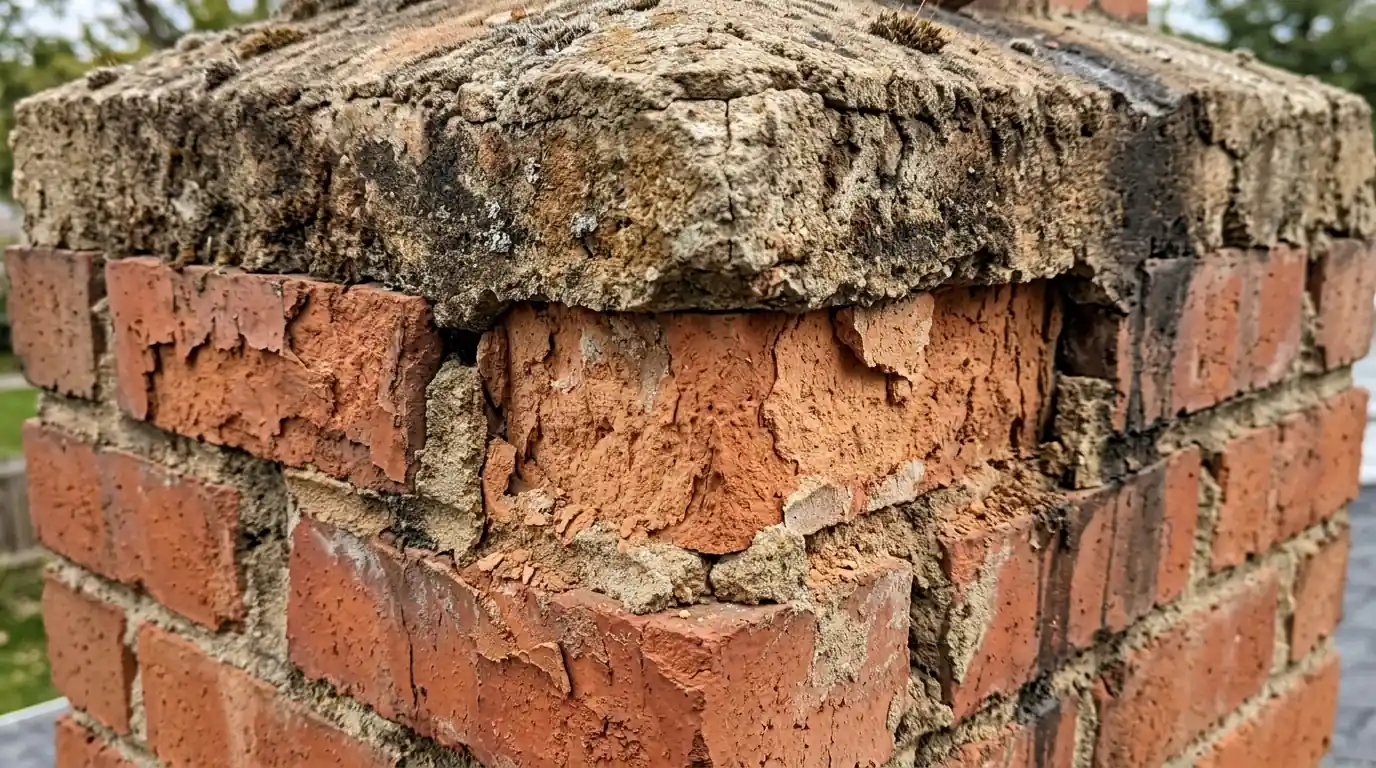
Spalling is when the face of a brick flakes, pops off or crumbles. It happens when brick absorbs water and that water freezes. Central Oklahoma winters swing above and below freezing over and over, so a wet brick can go through many freeze-thaw cycles in one season.
We replace spalled bricks by cutting out the damaged units and setting new or salvaged bricks that match in size, color and texture. On historic chimneys, matching older soft brick matters; a hard modern brick next to an old soft one can push damage into the surrounding units over time.
Mortar joints are meant to wear out before the brick does. Over time they erode, crack and recess, especially on the west and south faces that take the most sun and storms. Once joints are open, water goes straight into the chimney.
Repointing means grinding or raking out failed mortar to a consistent depth and packing in fresh mortar in layers. Mortar mix matters: older chimneys often need a softer lime-based mortar that's compatible with older brick, while newer chimneys take a standard mix. We match joint color and profile so the repair blends in.
A chimney cap sits over the flue opening with a metal hood and mesh sides. It keeps rain from pouring straight down the flue, stops birds, squirrels and raccoons from nesting inside, and blocks embers from landing on the roof.
We install stainless steel or galvanized caps sized to the flue, or multi-flue caps that cover the full crown on chimneys with more than one flue. A cap protects the crown too, since it sheds water off the center of the chimney top.
When a chimney sits on the slope of a roof, water running down from above hits the back of it and has nowhere to go. Leaves, pine needles and shingle granules pile up there, and water backs up under the shingles. Ice can build there during freezing rain.
A cricket, also called a saddle, is a small peaked roof built on the uphill side of the chimney that splits water around both sides. Building codes generally call for one on chimneys wider than 30 inches, and we recommend them on most chimneys of that size. We frame it, sheathe it, cover it with underlayment, and flash it into both the roof and the chimney.
Proper chimney flashing has two layers. Step flashing is woven into each course of shingles along the sides of the chimney. Counter-flashing is cut into the mortar joints of the brick and bent down over the step flashing. The two overlap so the roof and the chimney can move separately without opening a gap.
Many leaks we find come from counter-flashing that was just glued to the face of the brick with roofing cement, or from step flashing reused through two or three reroofs. We cut a proper reglet into the mortar, install new step and counter-flashing, and seal the reglet with a masonry sealant. During a roof replacement, chimney flashing should always be replaced.
Water marks on the ceiling or wall beside the chimney usually point to flashing, crown or masonry leaks.
Visible cracks across the top of the chimney funnel rain into the brick and the flue area.
Spalling brick means water is getting into the masonry and freezing through the winter.
Joints you can scratch out with a key or that sit well back from the brick face need repointing.
Flashing pulling away from the brick, or sealed only with tar, will leak in wind-driven rain.
Leaves and granules stacked on the uphill side mean water is backing up and a cricket may be needed.
The same people who look at your roof are the ones who do the work, and they explain each step before it happens.
Call (405) 864-0080We check the crown, brick, mortar, cap and flashing, and photograph every face of the chimney.
We look in the attic and around the chimney chase to see where water is actually entering.
We lay out what needs repair, what can wait, and how the masonry and roofing work fit together.
Bricks are replaced, joints repointed and the crown rebuilt before any new flashing goes on.
New step and counter-flashing, a cricket if needed, and a cap are installed, then we water test.
Every roof is priced after we have seen it. These are the things that move the number up or down.
Call any hour. Our own crew inspects, photographs and explains the fix before any work starts.
Wind-driven rain hits the chimney face and forces water through porous brick, open mortar joints and poorly sealed counter-flashing. Gentle rain may not get past them. The fix is usually flashing and masonry repair, sometimes with a cricket behind the chimney.
If your chimney is wider than about 30 inches along the slope, or debris and water pile up behind it, a cricket helps divert water around it. Building codes generally call for one at that width, and it's the best time to add one during a reroof.
Usually, yes. Individual spalled bricks can be cut out and replaced. If damage is widespread or the upper courses are loose or leaning, the top of the chimney may need to be taken down and rebuilt above the roofline.
Yes. Reusing old step flashing and counter-flashing is one of the most common sources of leaks in new roofs. New flashing woven into new shingles and cut into the mortar gives the chimney a fresh seal.
No. Our chimney work covers the masonry above the roof, the crown and cap, and the flashing that ties the chimney into the roof. Sweeping, flue liners and fireplace inspections are handled by chimney sweeps.
Repair and replacement of step, counter, chimney, wall, valley and pipe boot flashing, the joints where most roof leaks begin.
Learn moreWe trace a leak back to its true entry point, often feet away from the ceiling stain, and seal the real opening for good.
Learn moreFull tear-off roof replacement in Oklahoma City, from decking checks and underlayment to a magnet sweep of your yard.
Learn moreClay and concrete tile roof repair and installation in Oklahoma City, from cracked tile swaps to new underlayment.
Learn moreOklahoma City and the surrounding metro, including:
Quail Creek, Oklahoma CityWindsor Hills, Oklahoma CityEdgemere Park, Oklahoma CitySouthern Oaks, Oklahoma CityMooreBethanyWarr AcresOklahoma CountyAll service areas