Flat Roof Repair
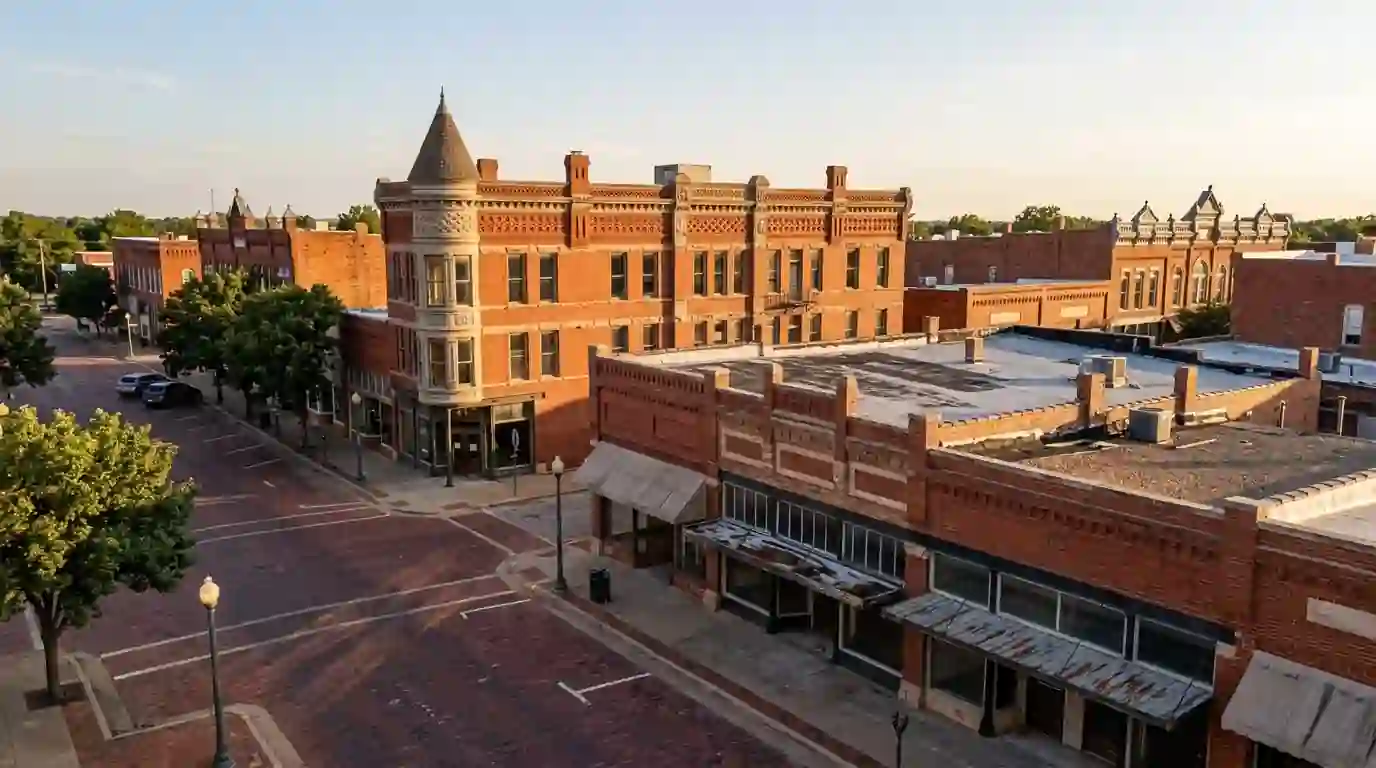
Downtown Guthrie's historic commercial buildings mostly have flat or low-slope roofs behind their front cornices, with aging membranes and parapet flashing.
Learn moreSapphire Roofing has an office on North 2nd Street in downtown Guthrie, so Guthrie and the rest of Logan County are home turf for our crews. We repair and replace roofs on everything from older brick homes near downtown to newer houses on acreage outside town, plus low-slope roofs on commercial buildings. Call us any hour for an inspection with photos.
Answered 24/7Our own crews work in Guthrie.
Guthrie is where our north office sits, on North 2nd Street in the brick blocks of the old downtown. Having a desk here means Guthrie homeowners and building owners don't wait on a crew driving up from the city. When a storm comes through Logan County, we're already in town.
Roofing in Guthrie is different from roofing in a newer suburb. The town was settled in a single afternoon during the Land Run of 1889, served as the territorial capital and then the first state capital, and kept a remarkable amount of its early building stock. That history sits right next to farmhouses, mid-century ranch homes and new construction on the edges of town, and each needs a different approach.
About 10,000 people claimed lots at the Guthrie site within hours of the 1889 Land Run. The town became Oklahoma's territorial capital and then its first state capital in 1907, until voters moved the capital to Oklahoma City in 1910. That loss slowed growth for decades, and a side effect was that much of the original downtown was never torn down.
The Guthrie Historic District was designated a National Historic Landmark in 1999. Its core is two and three-story commercial buildings of red brick and sandstone built between 1889 and 1910, many by the Belgian-born architect Joseph Foucart, whose turrets and oversized arched windows give downtown its distinctive look.
Behind the ornate front cornices, most downtown Guthrie buildings have flat or low-slope roofs that drain toward the back or to internal scuppers. The trouble spots are predictable: membrane seams that have opened, parapet walls where the flashing has pulled away from old brick, and clogged scuppers that let water pond and find a way in.
Repairs here call for care with masonry. We terminate new flashing into the mortar joints rather than gluing it to the face of the brick, and we choose membranes like modified bitumen or TPO based on the building's drainage, foot traffic and what's already up there. Guthrie's historic preservation committee reviews certain exterior changes in the district through certificates of appropriateness, so check with the city before changing anything visible from the street.
The neighborhoods surrounding downtown hold many solid brick and frame homes from the late 1800s and early 1900s, including Queen Anne and Colonial Revival houses with steep pitches, turrets, dormers and deep eaves. Roofs like these have more valleys, more wall flashing and more transitions than a modern ranch house, and that's where leaks start.
On these homes we take our time with chimney flashing, dormer cheek walls and the small low-slope sections over porches and bay windows. When a full replacement is needed, we talk through options such as architectural shingles in a color that suits the house, or metal where it fits the style, and we photograph original details so they can be preserved.
Outside the historic core, Guthrie spreads into farmland and rural subdivisions with homes on large lots, plus newer construction along the Interstate 35 corridor. Those houses usually carry architectural shingles or metal and take the full force of wind across open pasture.
Logan County sees the same spring hail and tornado season as the rest of central Oklahoma, along with ice storms that load trees and gutters in winter. Because homes on acreage are often far apart, a single storm can damage roofs across miles of county road. Our Guthrie office lets us cover that ground quickly.
Because our north office is in downtown Guthrie, we can usually look at a Guthrie roof the same day you call, and come back quickly for follow-up work. We answer 24/7, so if a storm opens up a roof at night, we'll get a tarp on it as soon as conditions are safe.
Every Guthrie job is done by our own crews. We inspect, photograph what we find, explain it in plain language, and if your damage is storm-related, we walk you through how the insurance claim process works. We don't negotiate your claim for you, but we document the roof thoroughly so the adjuster sees what we see.
Downtown Guthrie's historic commercial buildings mostly have flat or low-slope roofs behind their front cornices, with aging membranes and parapet flashing.
Learn moreOlder brick homes and storefronts here leak most often where flashing meets masonry walls and chimneys.
Learn moreMany late 1800s and early 1900s Guthrie homes still have original brick chimneys that need flashing and crown work.
Learn moreHomes on acreage around Guthrie often choose metal for its wind resistance across open Logan County pasture.
Learn moreLogan County takes the same spring hail as the rest of central Oklahoma, and storms here can damage roofs across miles of county road.
Learn moreCall Sapphire. Our own roofers inspect, photograph and fix the problem, and we explain it first.
Guthrie's historic preservation committee reviews certain exterior changes in the district through certificates of appropriateness. Check with the city before changing anything visible from the street, especially roof material or color. We can supply material details and photos for your application.
Yes. We repair and replace low-slope membranes, rebuild parapet flashing into the mortar joints, and clear or rework scuppers so water drains instead of ponding. We photograph everything so you can see the condition of the roof you rarely get to look at.
Our north office is on North 2nd Street downtown, so Guthrie is home ground for us. We answer 24/7 and can usually inspect the same day, and we can tarp a storm-damaged roof as soon as it's safe to get on it.
It depends on the house, but owners in open country often pick metal, such as standing seam or stone-coated steel, or Class 4 impact-resistant shingles for hail. We'll walk through the options, what drives cost for each, and how each one handles wind on an exposed lot.