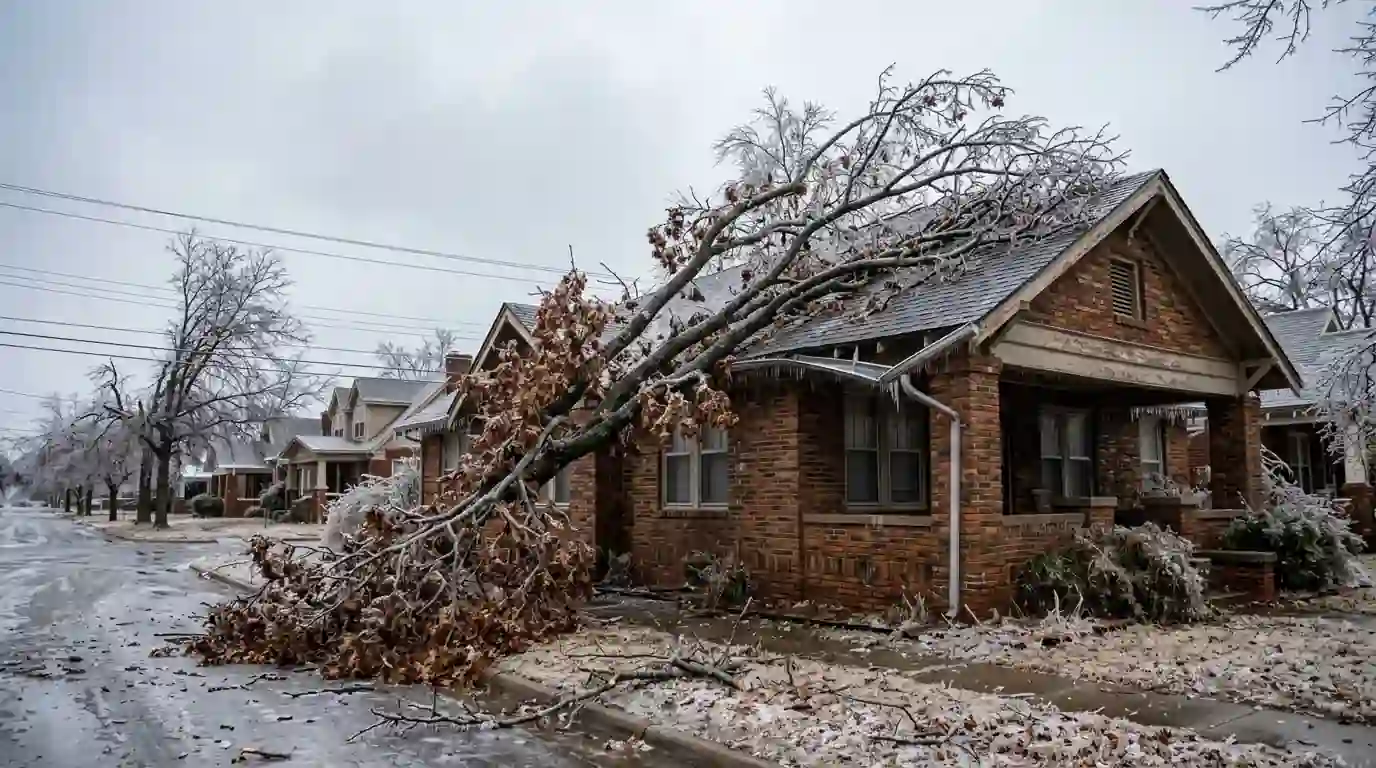
Ice loads trees until limbs snap, and in Oklahoma City the trees nearest the house do the most roof damage. Trim limbs back from the roofline, remove dead or split branches, and watch big trees with weak forks. If a limb hits, get everyone away from that area, stay clear of downed lines, cover the opening and document the damage before cleanup.
In late October 2020, an ice storm coated central Oklahoma while most trees still had their leaves. The leaves caught far more ice than bare branches would have, and limbs snapped all over Oklahoma City for days. Hundreds of thousands of homes lost power, streets filled with branches, and a lot of roofs took hits from trees that had shaded them for decades.
Ice storms are not as frequent as hail here, but when they come they can do more damage to roofs in a single night than several years of normal weather. This guide covers how ice and trees damage roofs, how to reduce the risk, and what to do when a limb lands on your house.
Why the October 2020 storm hit trees so hard
Ice accumulates on every surface it touches. In a normal winter ice event, deciduous trees are bare, so there is less surface to coat. In October 2020, oaks, elms, pecans, Bradford pears and other trees were still fully leafed out, and each leaf became a shelf for ice. The added weight bent and then broke limbs that had survived years of wind.
Trees that had been topped, had weak V-shaped forks or had decay inside large limbs failed first. Fast-growing species with brittle wood, such as Bradford pear and silver maple, split badly. Many of the most damaged roofs were under large, mature trees planted close to the house in older neighborhoods.
How ice damages a roof by itself
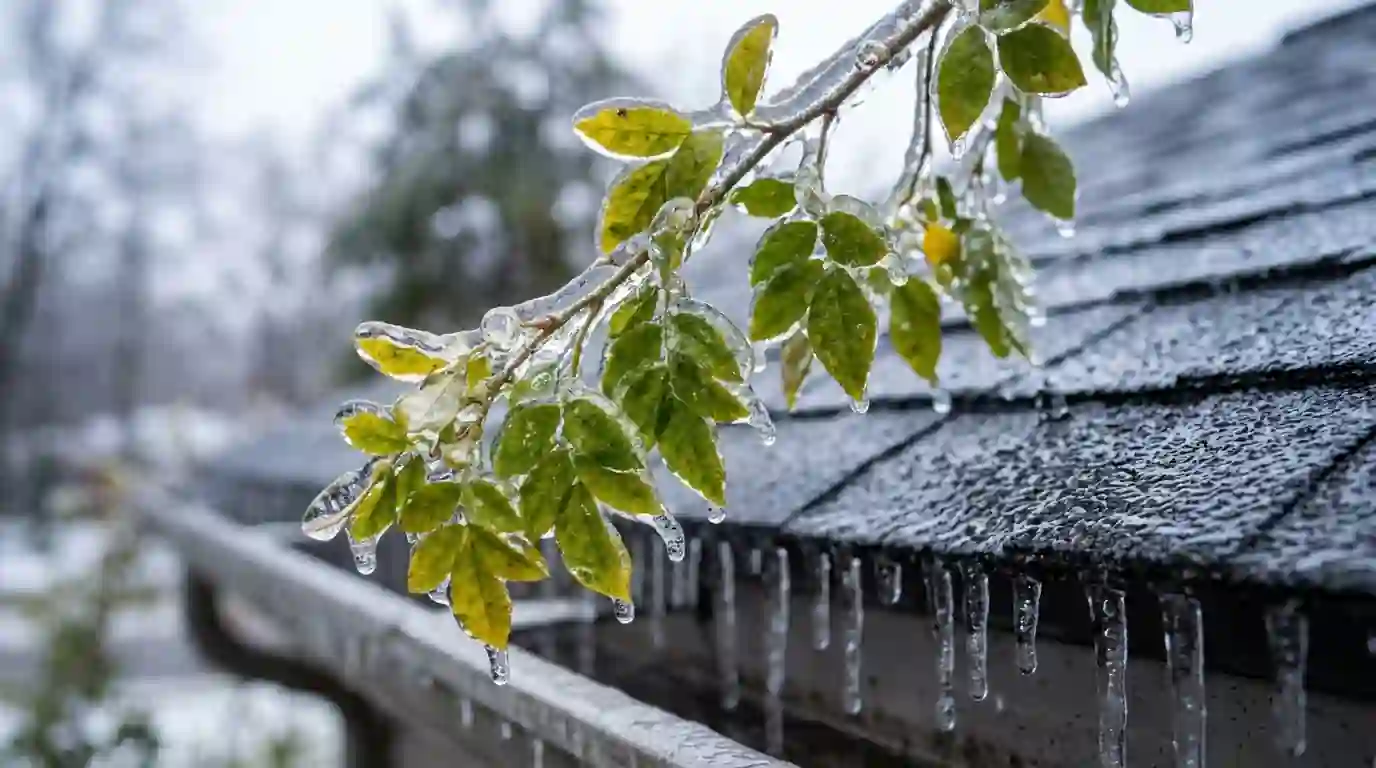
Even without falling limbs, ice is hard on roofs. Freezing rain coats shingles and fills gutters, and the weight can pull gutters away from fascia boards. When ice blocks gutters and roof edges, meltwater can back up under the shingles along the eaves and leak into soffits or walls.
Oklahoma's quick swings from freezing nights to sunny afternoons also mean repeated freeze-thaw cycles. Water that works into cracked shingles, open flashing or old sealant freezes and expands, widening the gap each time. Small roof defects that were harmless in summer can start leaking after an ice event.
Which trees near your roof need attention
Walk around the house and look up at every tree whose limbs could reach the roof if they fell. Pay the most attention to large limbs directly over the house, over the garage or over the spot where you park. Those are the ones that turn a storm into a roof claim.
If you are unsure whether a tree is sound, have a tree care professional look at it. Some problems, like internal decay, are only visible to a trained eye.
- Limbs that touch or hang directly over the roof
- Dead branches with no leaves in summer or bark peeling away
- Cracks, splits or cavities in the trunk or large limbs
- Narrow V-shaped forks where two big stems meet
- Trees leaning toward the house, especially with lifted soil at the base
- Bradford pear, silver maple and other brittle species close to the house
Trimming that actually protects the roof
A good rule is to keep branches several feet clear of the roof surface, so ice-loaded limbs do not sag onto shingles and wind does not let them scrape back and forth. Remove dead wood entirely. On large trees, thinning the crown reduces how much ice and wind the tree catches without harming its health.
Avoid topping, the practice of cutting big limbs back to stubs. Topped trees regrow with weakly attached shoots that break easily in the next ice or wind storm. Late winter, before spring growth starts, is a common time to prune many shade trees in Oklahoma, but dead or hazardous limbs over the roof should come down whenever you find them.
When a limb hits the roof: safety first
If you hear a crash, get everyone out of the rooms under that part of the roof. A limb may have cracked rafters or decking, and the ceiling can come down without warning, especially if water is collecting above it.
Look outside before you go out. During an ice storm, power lines often come down with the same limbs, and they can be live even when the house has no power. Stay well away from any line touching the tree, the roof or the ground, and report it to the utility. Do not climb on an iced roof or try to pull a heavy limb off yourself.
Covering the damage and stopping water
Once it is safe, the priority is keeping water out. Inside, place buckets and towels, move furniture and electronics, and if water is near light fixtures, turn off that circuit at the breaker. Your policy likely expects you to take reasonable steps to prevent further damage.
On the roof, a crew removes the limb in sections, checks the framing for cracks, and covers the opening with plywood and a heavy tarp fastened to boards. A tarp alone over a hole will sag and collect water, so the opening often needs a temporary patch before the tarp goes on. The tarp should run up and over the ridge where possible, so rain cannot run underneath it from above.
Documenting tree damage for your insurer
Before the limb is cut up, take photos and video from several angles: the tree, where the limb broke, where it landed, and the damage inside. Insurers often look at whether a tree was healthy before the storm, so photos of the break point help show it was storm damage rather than long-term neglect.
Keep receipts for tarping, tree removal and emergency supplies. Many policies treat tree removal differently depending on whether the tree hit a covered structure, so ask your insurer how your policy handles it.
How Sapphire helps after an ice storm
Sapphire answers 24/7, including during ice storms. Our own crews tarp roofs, work alongside tree crews to clear limbs safely from the roof, and inspect the framing, decking and shingles once the limb is off. We photograph each step so you have a clear record.
After the emergency is handled, we explain whether the damage needs a section repair, decking replacement or a larger job, and we also check gutters and fascia that ice may have pulled loose. Call Sapphire from anywhere in the metro; our crews work out of south Oklahoma City and Guthrie.